Green Building & Materials
Fly Ash Blocks vs Regular Cinder Blocks: Which Is Better for Your Project?
Walk into any building materials discussion in 2026 and you'll hear "fly ash blocks" come up alongside the usual talk of cinder blocks and CMU. Some contractors swear by them. Others have never touched one. The marketing around sustainable building can make it hard to separate genuine benefit from greenwashing. So let's cut through the noise — here's an honest, side-by-side look at fly ash blocks and regular cinder blocks, and which one actually makes sense for different types of projects.
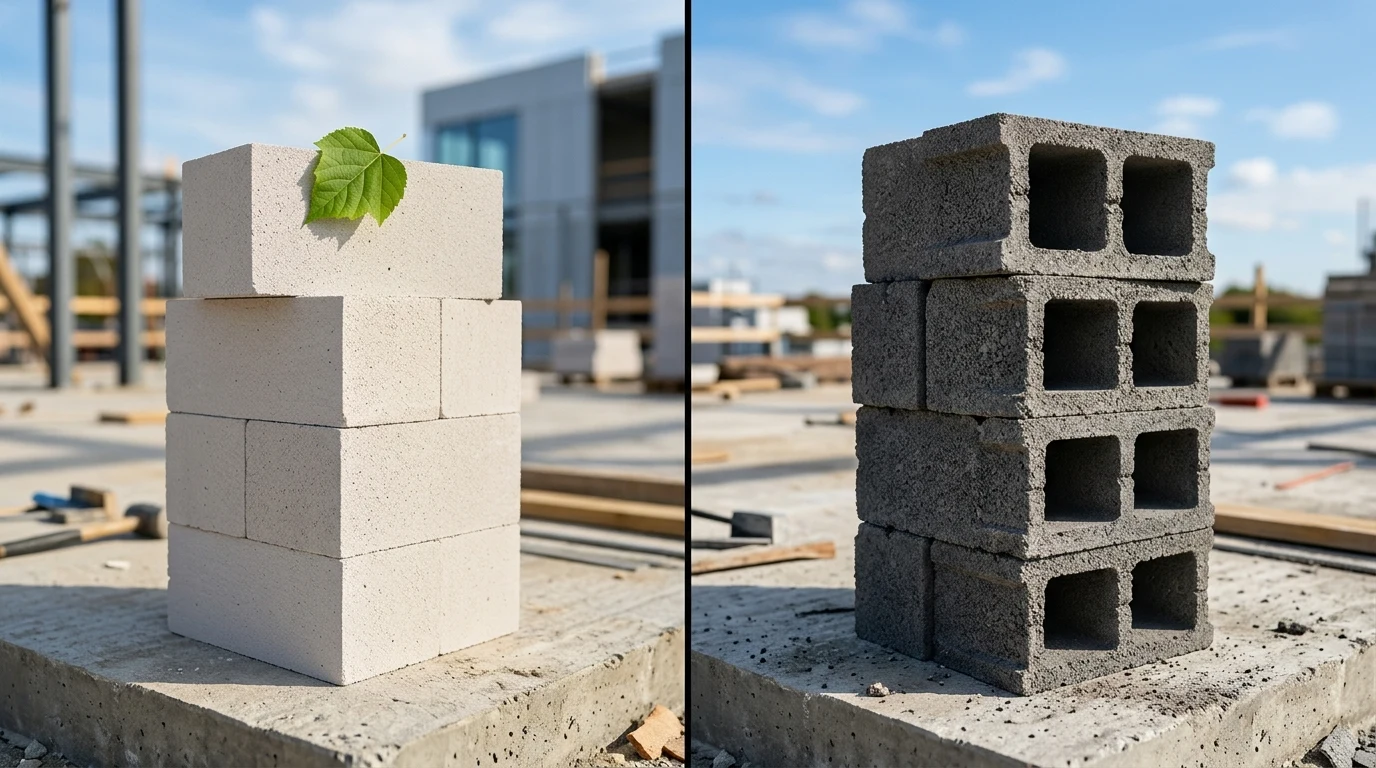
Left: fly ash blocks — lighter, paler, and more porous. Right: standard CMU cinder blocks — denser, darker, and more widely available. Both have their place.
What to verify for your project
Use the product sheet for strength, absorption, and applications. The EPA evaluation covers fly ash in concrete and does not establish structural performance or environmental claims for every block SKU. See EPA’s evaluation of encapsulated fly ash in concrete.
First, Let's Clear Up the Confusion About Names
Before getting into the comparison, it's worth untangling the terminology because it trips people up constantly.
"Cinder block" is the old-fashioned name for a concrete masonry unit (CMU). True cinder blocks — made with coal cinder ash — were phased out in the mid-20th century. What most people call cinder blocks today are actually standard hollow concrete blocks, made from Portland cement, aggregate (sand and gravel), and water. The name stuck even though the material changed.
"Fly ash blocks" can mean a few different things, and that's where the confusion starts. There are two main types:
- Fly ash blended CMU — a standard hollow concrete block where some of the Portland cement has been replaced with fly ash (a byproduct of coal combustion). This looks almost identical to a regular CMU but has a lower carbon footprint.
- AAC blocks (Autoclaved Aerated Concrete) — a completely different product that uses fly ash or silica sand, cement, lime, and aluminum powder, then steam-cures it under pressure. The result is a cellular, lightweight block that's fundamentally different from hollow CMU in almost every way.
When contractors or homeowners say "fly ash blocks," they usually mean AAC. When builders say "fly ash blended CMU," they're talking about a greener version of a standard block. This article covers both — because they compete with standard CMU in different situations and for different reasons.
The Head-to-Head Comparison
| Property | Standard CMU (Cinder Block) | AAC Fly Ash Block | Winner |
|---|---|---|---|
| Weight (8" block) | 38–50 lbs | 20–28 lbs | 🌿 AAC |
| Compressive strength | 1,900–3,000+ psi | 300–900 psi | 🏗 CMU |
| Thermal insulation (R-value) | R-1.1 to R-1.5 per inch | R-3.5 to R-4.5 per inch | 🌿 AAC |
| Fire resistance | 2–4 hour rating | 4+ hour rating | 🌿 AAC |
| Sound insulation (STC) | 45–55 STC | 40–45 STC | 🏗 CMU |
| Ease of cutting/shaping | Requires masonry saw, hard on blades | Cuts with hand saw or band saw | 🌿 AAC |
| Mortar/adhesive needed | Standard mortar, 3/8" joints | Thin-set adhesive, 1/8" joints | 🌿 AAC |
| Carbon footprint | Higher (mostly Portland cement) | 30–50% lower than CMU | 🌿 AAC |
| Cost per block (approx.) | \$1.50–\$3.50 | \$3.00–\$6.00 | 🏗 CMU |
| Availability | Universal — every supply yard | Regional — not always stocked locally | 🏗 CMU |
| Water/moisture resistance | Good with waterproofing | Porous — needs proper sealing | 🏗 CMU |
Where Fly Ash Blocks (AAC) Are Genuinely Superior
Thermal Performance — It's Not Even Close
This is the biggest practical difference and the reason AAC blocks have taken over residential construction in parts of Europe, India, and increasingly the American South and Southwest.
A standard 8-inch hollow CMU wall, even partially grouted, delivers somewhere around R-4 to R-8 total wall assembly — and that's with insulation added. An 8-inch AAC block wall on its own delivers R-8 to R-12 from the block alone, before you add any additional insulation. In climates where keeping heat out (or in) matters, that difference shows up directly on energy bills.
As energy codes tighten across the US — 2024 and 2025 IECC updates have pushed minimum wall R-values higher in most climate zones — AAC walls often meet code on their own or with minimal additional insulation. Standard CMU walls typically need dedicated exterior or interior insulation systems added, which adds cost and complexity.
Weight and Labor — 40% Lighter Changes Everything
An 8x8x16 standard CMU block weighs around 38 to 50 pounds depending on whether it's lightweight or normal-weight aggregate. An equivalent AAC block comes in at 20 to 28 pounds. That's nearly half the weight per block.
On a residential project with thousands of blocks, that weight difference is felt by every worker on site, every day. Lower worker fatigue means better quality work in the afternoon, fewer injuries, and less strain-related downtime. Contractors who've switched to AAC for residential walls report noticeably better mason productivity on full-day pours, even though the adhesive technique with AAC requires its own learning curve.
The lighter weight also matters for delivery and handling. AAC pallets are significantly easier to maneuver, and the blocks can often be placed by one person where CMU would require two.
Workability — Cuts Like Wood, Not Rock
Standard CMU is hard on tools. Cutting it requires a wet-cut masonry saw or an angle grinder with a diamond blade, kicking up concrete dust and grinding through blades. Fitting blocks around MEP (mechanical, electrical, plumbing) penetrations is time-consuming and messy.
AAC cuts cleanly with a hand saw or a band saw. Electrical chases can be routed with a standard router or even a chisel. Plumbing runs can be cut with a hole saw. The cellular structure of AAC makes all of this dramatically faster and cleaner than working with dense CMU. On complex residential builds with lots of openings and utility runs, that workability advantage compounds into meaningful time savings.
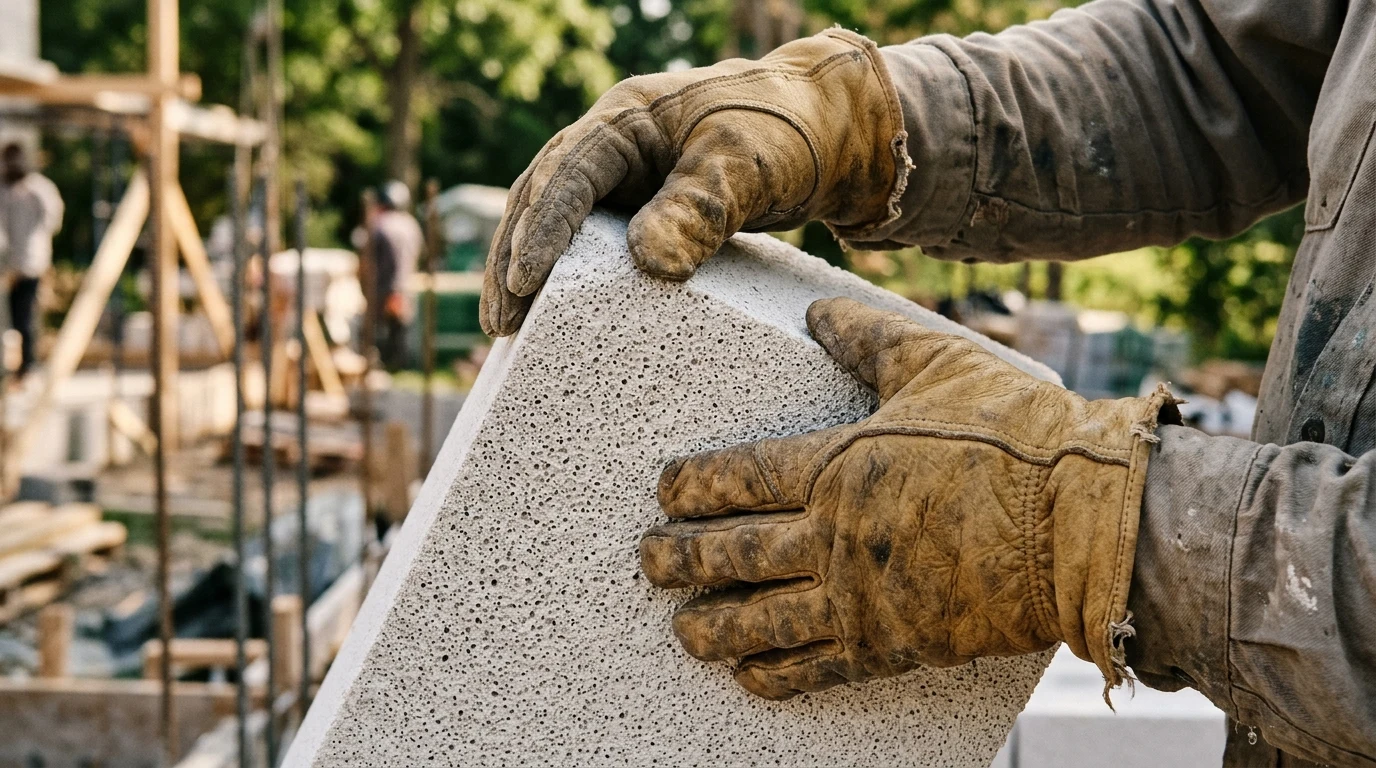
The cellular structure of AAC fly ash blocks makes them dramatically lighter and easier to work with than standard cinder blocks — but that same structure means lower compressive strength.
Environmental Impact — The Numbers Are Real
Portland cement production is genuinely one of the largest industrial sources of CO₂ globally. Producing one ton of Portland cement releases roughly 0.9 tons of CO₂. Fly ash — whether used to blend into standard CMU or as a key ingredient in AAC — displaces a significant portion of that cement.
AAC blocks typically have a carbon footprint 30 to 50 percent lower than an equivalent volume of standard CMU. Fly ash blended CMU (where 20–40% of the cement content is replaced with fly ash) sits somewhere in between — lower than conventional CMU but higher than AAC.
For projects pursuing LEED certification, IGCC compliance, or local green building credits, fly ash content in masonry units often counts directly toward Materials & Resources credits. Builders working on institutional or commercial projects with ESG reporting requirements increasingly find that specifying fly ash products simplifies their documentation significantly.
Where Standard CMU Still Wins — And Wins Clearly
Structural and Retaining Wall Applications
This is the most important caveat about AAC and it doesn't get enough attention in eco-building content: AAC blocks are not suitable for heavily loaded structural walls, retaining walls, or below-grade applications without significant engineering input and often reinforcement systems that standard CMU handles more naturally.
With compressive strength typically ranging from 300 to 900 psi — compared to 1,900 to 3,000+ psi for standard CMU — AAC simply can't carry the same loads. A basement foundation wall holding back soil and carrying a floor and roof load? That's CMU territory. A retaining wall holding back a slope? CMU. A reinforced structural wall in a high-seismic zone? CMU.
AAC has been engineered for structural use in some applications — there are AAC structural wall systems with reinforcement, and some manufacturers publish structural load tables for their products. But the typical homeowner or contractor reaching for AAC blocks should treat them as non-structural or lightly structural unless a licensed engineer has specifically reviewed the application.
Sound Insulation
Dense mass blocks sound. AAC's cellular structure — which is wonderful for thermal performance — actually reduces its sound transmission class (STC) compared to a solid or grouted CMU wall. If you're building a party wall between units, a home studio, a mechanical room, or any application where sound isolation is a primary goal, standard CMU or grouted CMU is the better choice.
Below-Grade and High-Moisture Environments
AAC is porous. That porosity is what gives it its light weight and thermal properties — the air cells inside the block. But those same air cells can absorb and hold water if the block isn't properly sealed and if it's installed in conditions where it's regularly exposed to moisture.
Standard CMU, while not waterproof on its own, is significantly more resistant to moisture absorption and doesn't rely on sealing for structural integrity in the same way. Below-grade walls, retaining walls, walls in wet climates without reliable exterior drainage, and pool enclosures are all applications where CMU's density is a genuine advantage over AAC.
What About Fly Ash Blended CMU? The Middle Ground
If AAC seems like a step too far from what you're familiar with, fly ash blended CMU is worth knowing about — especially for commercial projects where sustainability metrics matter but so does structural performance.
These blocks look, feel, and install exactly like standard CMU. They use the same mortar, the same reinforcing systems, the same grout. The difference is that 20 to 40 percent of the Portland cement has been replaced with fly ash, reducing embodied carbon and often improving long-term durability (fly ash concrete tends to develop higher strength over time and is more resistant to sulfate attack and alkali-silica reaction).
The performance difference on site is essentially nil. Compressive strength is comparable. The blocks meet ASTM C90 specifications just like standard CMU. The only changes are on the materials side: lower carbon content and often slightly lower cost, because fly ash is cheaper than Portland cement per unit of cementitious value.
If your supplier carries fly ash blended CMU at a comparable or lower price to standard blocks, there's almost no reason not to use it. The structural performance is equivalent, the installation is identical, and the environmental benefit is real. It's the easiest green building swap in masonry.
The Real-World Decision: Which Should You Choose?
After all the technical comparison, here's how to actually make the call for your specific project:
- Building a residential above-grade wall in a warm climate? AAC fly ash blocks are likely your best choice. The thermal performance improvement is significant, the lighter weight makes the build faster and safer, and the lower carbon footprint is a genuine benefit.
- Building a foundation, basement wall, or retaining wall? Standard CMU. No question. The structural requirements and moisture conditions favor dense block, and AAC isn't the right tool for this job without significant engineering involvement.
- Building a commercial structure with green building requirements? Check with your supplier about fly ash blended CMU first — it's the lowest-friction sustainable switch and maintains full structural performance. If the project has aggressive embodied carbon targets, specify AAC for non-structural interior partition walls.
- Building a garden wall, boundary wall, or decorative feature wall? Either works. If aesthetics matter and you're planning to paint or plaster, AAC's smooth surface takes finishes beautifully. If you want split-face or exposed aggregate texture, CMU is the way to go.
- Doing a small DIY project? AAC wins on workability every time. The ability to cut with hand tools and work without a masonry saw makes it dramatically more accessible for homeowner-level work. Just make sure it's sealed properly against moisture.
Cost: Is the Premium Worth It?
AAC blocks typically cost roughly double what standard CMU costs per block — somewhere in the $3 to $6 range versus $1.50 to $3.50 for standard CMU. That sounds like a big premium, and on paper it is.
But the total installed cost comparison is more nuanced than the block price alone suggests. AAC's thin-set adhesive joints use far less material than standard mortar joints. The lighter blocks reduce labor time per unit placed. Fewer cuts mean less material waste and less saw time. And AAC's superior thermal performance can reduce the cost of insulation systems, mechanical equipment sizing, and long-term operating costs.
On a full residential wall system, the premium for AAC over standard CMU often shrinks to 10 to 25 percent of total installed cost — and in energy-efficient building contexts, the payback from reduced HVAC load can make up the difference within a few years of occupancy.
Fly ash blended CMU, on the other hand, is frequently available at parity with or even below the cost of standard CMU, depending on your market and supplier. If your local masonry yard stocks it, this is genuinely the greenest no-cost upgrade available in block construction.
Bottom Line
The fly ash vs. cinder block debate isn't really about which is "better" in some absolute sense. It's about understanding what each material is optimized for and matching that to your project's actual needs.
Standard CMU — the humble cinder block — is still the most structurally capable, most widely available, and most cost-predictable masonry unit on the market. For anything that carries serious load, retains soil, or sits below grade, it remains the right answer in 2026.
Fly ash blocks — whether AAC or blended CMU — offer genuine advantages in thermal performance, workability, worker safety, and environmental footprint that are increasingly hard to ignore as energy codes tighten and ESG reporting spreads from commercial to residential construction. For above-grade residential walls, the case for AAC is stronger than it's ever been.
The best contractors in 2026 aren't choosing one or the other permanently — they're using both strategically. CMU below grade and for structural elements. AAC above grade for living spaces. Fly ash blended CMU as a default wherever standard CMU would have gone, because the green upgrade is free. That's the practical approach, and it's the one that makes the most sense for builders, homeowners, and the planet.