Masonry & Concrete
Concrete Driveway Cost: What Affects the Price?
A concrete driveway is one of the most durable and cost-effective investments you can make in your home's exterior. It can last 30 to 50 years with minimal upkeep — far longer than asphalt, which typically needs replacement or significant resurfacing within 20 years. But concrete driveway costs vary widely, and homeowners who don't understand the variables often end up either overpaying or accepting a job that cuts corners on the details that actually determine longevity.
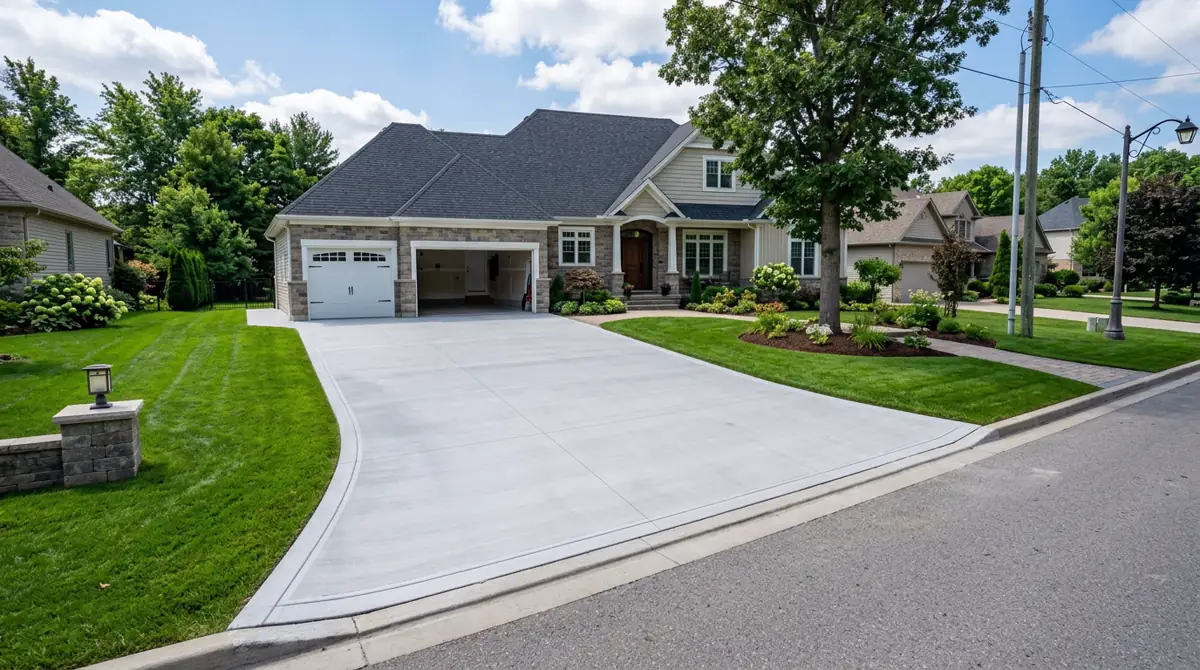
A properly installed concrete driveway with clean expansion joints and correct drainage slope will last decades without major repairs.
Factor 1: Size and Shape
The most obvious cost driver is square footage — more concrete means more material and more labor. But shape matters nearly as much as area. A simple rectangle is the easiest and cheapest layout to form and pour. Curved edges, flared aprons, turnarounds, and irregular boundaries all require more forming time, more careful finishing work, and more concrete waste at cuts.
Standard residential driveway widths run from 10 feet (single lane) to 24 feet (two-car), with depths of 18 to 24 feet from the garage to the street being typical. Wider driveways and those with large apron areas at the street can add significantly to the total area — and to the cost — beyond what homeowners initially estimate. Measure the full footprint, including any turnaround pads, before requesting bids.
Single-Car (10–18 ft)
~180 sq ft. Basic access, one lane. Common for older homes with single-bay garages.
Two-Car (20–30 ft)
~600 sq ft. Standard suburban two-car garage approach with moderate apron.
Large / Circular
900–1,500+ sq ft. Extended approaches, turnarounds, or decorative layouts.
Factor 2: Concrete Thickness
Thickness is one of the most important structural decisions in a concrete driveway — and the one most commonly cut short by contractors trying to win a bid at the lowest price.
The minimum recommended thickness for a residential driveway serving passenger vehicles only is 4 inches. This is adequate for cars and light SUVs when properly reinforced and supported on a prepared subbase. If the driveway will regularly carry heavier loads — pickup trucks with trailers, recreational vehicles, delivery trucks, or concrete mixers — 5 to 6 inches provides meaningfully better load distribution and crack resistance.
Each additional inch of thickness increases material cost by roughly 20–25% and adds modestly to the forming and finishing labor. That cost increment is almost always worth it for driveways serving mixed or heavy use. A driveway that's too thin will develop structural cracks within a few years in ways that cannot be repaired — only replaced.
Factor 3: Reinforcement Type
Concrete is strong in compression but weak in tension. Reinforcement — whether wire mesh or steel rebar — controls cracking when the slab shifts or settles unevenly. It doesn't prevent all cracking, but it keeps cracks from widening and compromising the slab's structural integrity.
| Reinforcement Type | Typical Use | Approximate Added Cost | Notes |
|---|---|---|---|
| Wire mesh (WWF) | Standard residential driveways | $0.40–$0.80/sq ft | Effective when properly positioned in the middle of the slab — not dragged along the bottom |
| #3 Rebar grid (12"—12") | Heavier loads, expansive soils, freeze-thaw regions | $1.00–$1.80/sq ft | Substantially better crack control; preferred by structural engineers for driveways |
| Fiber reinforcement | Added to mix for plastic shrinkage crack control | $0.10–$0.25/sq ft | Often used in addition to wire or rebar, not as a replacement |
| No reinforcement | Should not be used for driveways | — | Unreinforced slabs crack and shift; avoid any contractor who omits reinforcement |
Factor 4: Subbase Preparation
What's under the concrete is at least as important as the concrete itself. A properly prepared subbase distributes load, provides drainage, and prevents differential settlement that causes slabs to crack or heave.
A standard subbase involves removing existing material to depth, compacting the native soil, and placing 4 to 6 inches of compacted gravel (typically crushed stone or road base aggregate). In areas with expansive clay soils, poorly draining subgrades, or high frost penetration, additional depth, geotextile fabric, or even subbase stabilization may be required.
Subbase preparation is where the real difference between a 10-year driveway and a 40-year driveway lives. A contractor who skips or shortens subbase prep to save time and money delivers a slab that looks identical on pour day but fails years earlier. Ask specifically what thickness of gravel base is included in the bid and whether it will be mechanically compacted.
Factor 5: Finish Type
The surface finish affects both aesthetics and cost significantly. The most common options:
| Finish Type | Added Cost/Sq Ft | Appearance | Traction |
|---|---|---|---|
| Broom finish (brushed) | Base price — no add | Utilitarian, standard grey | Good — the texture adds grip |
| Salt finish | +$0.50–$1.50 | Pitted texture with subtle depth | Good |
| Exposed aggregate | +$2–$6 | Stone texture visible at surface; attractive and natural | Very good |
| Stamped concrete | +$6–$15 | Mimics brick, flagstone, cobblestone; premium look | Varies — can be slippery when wet if overly smooth pattern |
| Colored / integral pigment | +$1–$3 | Custom color added to the mix; can coordinate with home exterior | Same as base finish chosen |
Stamped concrete is the most dramatic upgrade — it genuinely looks like natural stone or brick — but it comes with a trade-off: the stamping process and sealers can make the surface more slippery when wet than a standard broom finish, and the decorative sealer needs to be reapplied every 2 to 3 years to maintain appearance. For driveways in wet or icy climates, a salt or exposed aggregate finish often provides a better combination of curb appeal and grip.
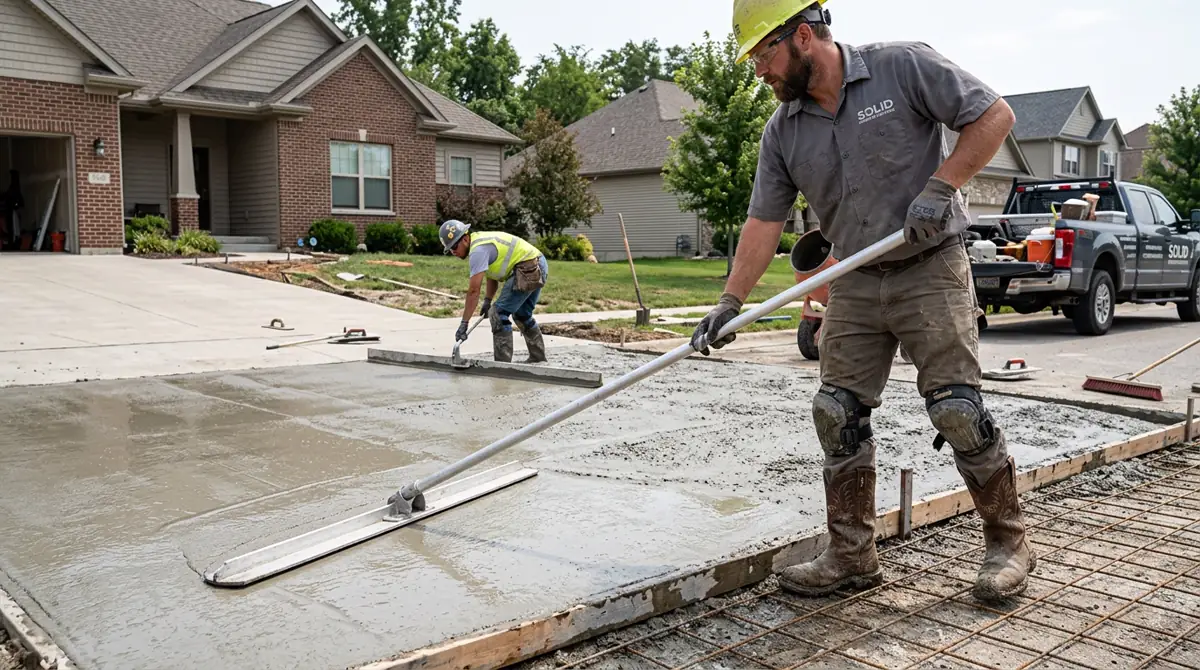
Concrete finishing is skilled, time-sensitive work. The slab must be worked at exactly the right stage of cure — too early or too late ruins the surface finish.
Factor 6: Expansion Joints and Control Joints
Concrete expands and contracts with temperature changes. Without joints to control where movement occurs, slabs crack randomly — often in the most visible and structurally damaging locations. Properly placed control joints (tooled grooves cut into the surface at 8 to 12 foot intervals) give the slab predetermined weak points where cracking occurs in a straight, controlled line beneath the surface.
Expansion joints (full-depth separations filled with compressible material) are used where the driveway meets the garage slab, the public sidewalk, and other fixed structures. These are not optional — omitting them guarantees that differential movement between the driveway slab and adjacent slabs will produce visible, ragged cracks at the connection point.
Joint placement and detailing is part of a professional concrete job and should not cost extra. If a contractor's bid doesn't mention control joints or expansion joints, ask what their plan is before signing.
Factor 7: Old Driveway Removal
If you're replacing an existing driveway — whether asphalt, concrete, or pavers — demolition and hauling adds real cost. Breaking up and removing old concrete requires a jackhammer or concrete saw, a dumpster or haul-away truck, and significant labor time.
Typical removal costs for an existing driveway run $1 to $3 per square foot, meaning a 600-square-foot driveway replacement adds $600 to $1,800 in demo cost before a new slab goes in. Some contractors include this in their per-square-foot pricing; others quote it separately. Always clarify what's included before comparing bids.
Factor 8: Slope, Drainage, and Site Conditions
A flat, accessible site with easy concrete truck access is the simplest scenario. Real-world sites often involve grades, narrow access, obstacles, or poor drainage that complicate the work and increase cost.
- Steep slopes require additional forming work to maintain proper slab thickness and may need stepped sections or drainage channels to prevent surface runoff from washing over the slab edge.
- Limited truck access may require a concrete pump, which adds $500–$1,500 to the job depending on pump size and pour volume.
- Poor soil drainage or high water tables may require deeper subbase preparation, french drains, or other drainage improvements before the slab goes in.
- Tree roots near the driveway footprint complicate subbase prep and can cause future heaving as roots grow — a conversation worth having with your contractor if large trees are nearby.
Factor 9: Regional Labor Rates
Concrete labor rates vary enormously by geography. The same 4-inch brushed driveway that costs $7 per square foot installed in rural Tennessee might cost $14 per square foot in the San Francisco Bay Area or New York City metro. This is not contractor markup — it reflects real differences in crew wages, equipment costs, insurance rates, and local material delivery expenses.
Always get at least three local bids rather than relying on national averages. National averages are useful for a reality check but not for budgeting a specific project in your specific market.
Sealing, Maintenance, and Long-Term Cost
The upfront installation price is only part of the true lifecycle cost. Concrete driveways should be sealed every 3 to 5 years with a penetrating or topical sealer, which costs $0.15 to $0.50 per square foot in product and minimal labor if you do it yourself. This single maintenance step is the biggest factor in preventing surface deterioration, reducing moisture infiltration, and maximizing the slab's lifespan.
Equally important: avoid applying chloride-based deicers (rock salt and many commercial ice melt products) to concrete during the first two winters, and minimize their use thereafter. Chlorides accelerate the freeze-thaw damage cycle in concrete and can cause surface scaling and spalling that is purely cosmetic at first but deepens over time.
What a Fair Bid Looks Like
A complete, professional concrete driveway bid should specify:
- Total square footage and slab thickness
- Subbase depth, material type, and compaction method
- Reinforcement type (mesh or rebar) and placement
- Concrete mix design — minimum PSI strength (3,000 PSI is standard residential; 4,000 PSI for heavier use)
- Finish type and any decorative options
- Joint locations and materials
- Whether old driveway demo is included and how debris will be disposed of
- Cure time before vehicle use (typically 7 days minimum, 28 days for full strength)
- Warranty on labor and any finish
If a bid is missing these details, ask for them in writing before signing. Bids that don't specify thickness, reinforcement, and mix design can be fulfilled at the cheapest possible specification — which may not be what you intended to purchase.
Estimate Your Concrete or Masonry Project
Use our CMU Block Calculator for masonry walls and foundations — or browse all our free estimating tools.
Frequently Asked Questions
How much does a concrete driveway cost per square foot?
Standard brushed concrete runs $6–$12 per square foot installed in most US markets in 2026. Decorative finishes (stamped, exposed aggregate) add $6–$15 per square foot. Site conditions, regional labor, and old driveway removal are common variables that push projects above the base range.
How thick should a concrete driveway be?
4 inches is the minimum for passenger vehicles. 5–6 inches is recommended for driveways that will carry trucks, RVs, or heavy equipment. The cost difference is modest relative to the improvement in durability and load capacity.
Does a concrete driveway need rebar?
All residential driveways should have at minimum wire mesh reinforcement. Rebar (typically #3 bar at 12-inch grid spacing) provides superior crack control for heavier loads, expansive soils, and freeze-thaw climates. It's worth the modest added cost on most projects.
How long does a concrete driveway last?
30–50 years with proper installation and basic maintenance. The key maintenance steps are sealing every 3–5 years and minimizing chloride deicer use in winter. The quality of the subbase preparation and the concrete mix are the largest determinants of long-term durability.