Plumbing & Utilities
Septic System Basics: Sizing, Maintenance & Costs
A well-designed septic system can quietly serve a home for decades, but it is not a set-it-and-forget-it appliance. Understanding the tank, drain field, sizing rules, routine maintenance, and early warning signs helps you protect one of the most important systems on a property.
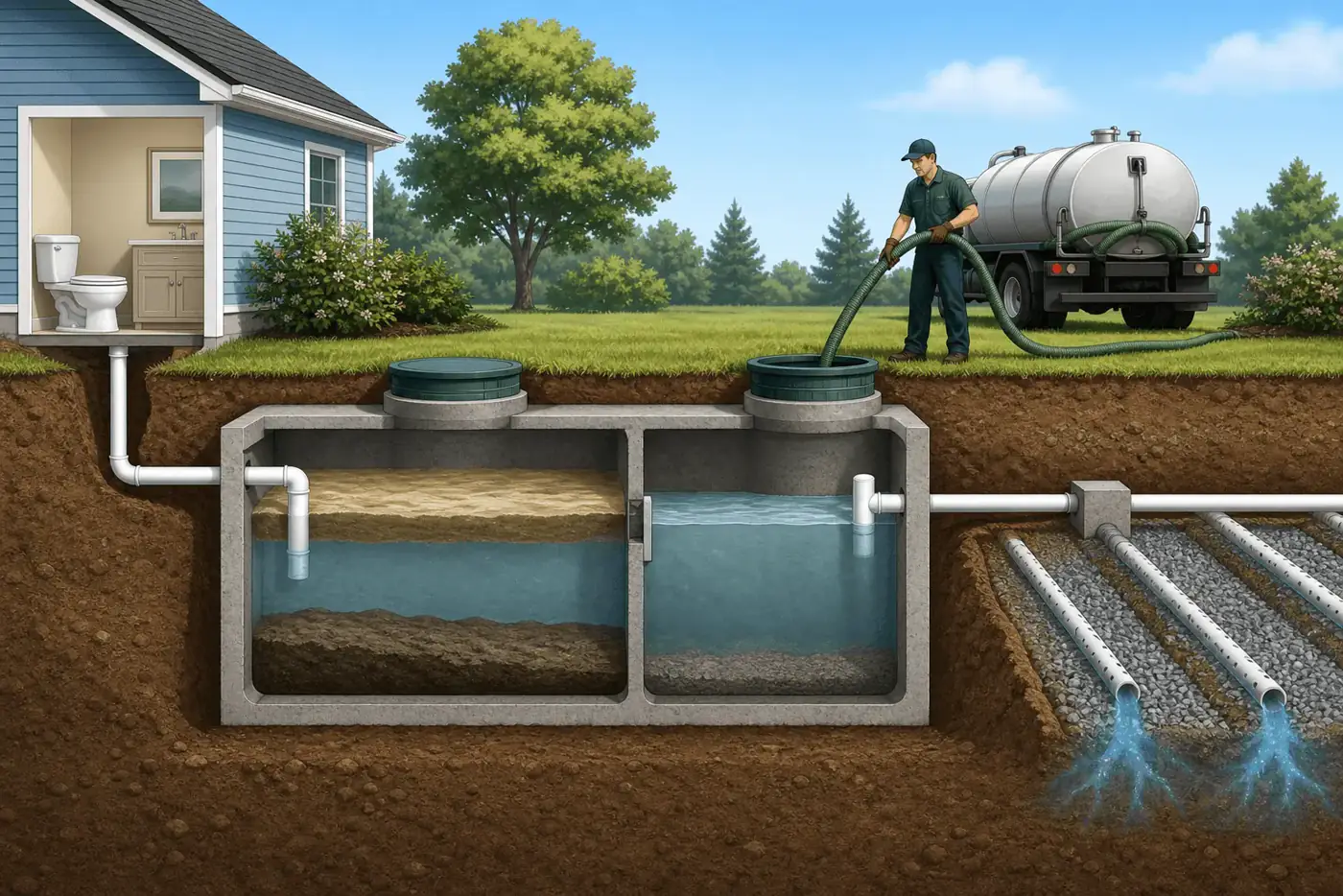
A septic system relies on both the tank and the soil-treatment area; each has a distinct job.
How a Septic System Works
A conventional septic system has two main parts: the septic tank and the soil-treatment area, often called the drain field or leach field. All wastewater from toilets, showers, sinks, and laundry flows through the building sewer and into the tank. The tank is not intended to treat every contaminant or store wastewater indefinitely. Its first job is separation.
Inside the tank, heavier materials settle to the bottom as sludge. Oils, grease, and other floating material form a scum layer at the top. Between them is a relatively clear liquid layer. Inlet and outlet baffles or tees slow the flow and help keep scum and solids from escaping. Anaerobic bacteria begin breaking down some organic material, but the tank still needs periodic pumping because solids do not disappear.
Effluent leaves the tank and enters a network of perforated pipe, chambers, or other approved distribution components in the drain field. The surrounding unsaturated soil filters and biologically treats the liquid before it moves deeper into the ground. This is why a septic tank alone is not a septic system: the drain field and the soil beneath it are essential treatment components.
Common components to know
- Building sewer: the pipe carrying household wastewater to the tank.
- Septic tank: a watertight concrete, polyethylene, or fiberglass vessel with approved access openings and baffles.
- Effluent filter: a removable filter at the outlet on many modern systems that needs periodic cleaning by a professional.
- Distribution box or pump tank: directs effluent evenly, or pumps it when the field is uphill or needs timed dosing.
- Drain field: the soil-treatment area that receives effluent after tank separation.
How Septic System Sizing Is Determined
There is no responsible one-size-fits-all answer to “What size septic system do I need?” A permitted design typically begins with the number of bedrooms or the approved design flow, then accounts for soil conditions and local rules. Bedroom count is commonly used because a system must support the potential occupancy of the home, not just the people who happen to live there today.
A site evaluation is just as important as the tank volume. A qualified evaluator looks at soil texture and structure, depth to seasonal groundwater or restrictive layers, slope, available area, setbacks from wells and property lines, and room for a replacement field. A percolation test may be part of the process, depending on jurisdiction. Fast-draining soil is not automatically ideal; soil must also provide enough treatment before effluent reaches groundwater.
| Planning factor | Why it matters | What to verify |
|---|---|---|
| Bedrooms/design flow | Sets the expected wastewater load and often the minimum tank capacity. | Approved plans and local health-department requirements. |
| Soil and site | Controls drain-field type, size, and whether an engineered system is required. | Soil evaluation, groundwater depth, slope, and setbacks. |
| Tank configuration | Capacity is only one issue; compartments, baffles, outlet filter, and traffic rating matter too. | Manufacturer cut sheet and installer specification. |
| Future use | A bedroom addition, rental use, or regular guests can exceed the original design load. | Permit conditions before changing use or adding bedrooms. |
These are planning considerations, not a substitute for a local permit, soil evaluation, or engineered design.
For many single-family homes, a 1,000- to 1,500-gallon tank is a familiar planning range, but local regulations vary sharply. The correct tank can still fail if the drain field is undersized, the wrong soil area is used, or roof and surface water are allowed to saturate the field. For a closer planning estimate, use our Septic Tank Calculator, then confirm the result with your local authority and septic designer.
Start with a planning-level size estimate
Use bedrooms, occupants, soil type, region, and garbage-disposal use to estimate tank capacity, drain-field area, pumping interval, and costs.
Septic System Maintenance That Protects the Drain Field
Most expensive septic failures begin as routine maintenance that did not happen. Pumping removes accumulated sludge and scum before they can pass through the outlet and clog the drain field. Inspection checks the tank structure, baffles, filters, pumps, alarms, and field condition. The appropriate interval depends on tank capacity, household size, water use, and what enters the drains.
As a broad rule, many household septic tanks are inspected about every three years and pumped every three to five years. A full household with a smaller tank or regular garbage-disposal use may need service more often. Do not rely on a calendar alone: ask the service provider to note sludge and scum levels, tank condition, and a recommended next service date in your records.
Habits that extend system life
- Use water efficiently. Repair running toilets, choose efficient fixtures, and spread laundry across the week rather than doing many loads in one day.
- Keep solids out. Put wipes, paper towels, feminine products, diapers, floss, cat litter, and coffee grounds in the trash, even when a package says “flushable.”
- Limit grease and food waste. Scrape plates into the bin; avoid sending fats, oils, and grease down the sink. A garbage disposal adds solids and can shorten pumping intervals.
- Protect the field. Do not drive, park, build, or place a heavy shed over the tank or drain field. Keep deep-rooted trees away from pipes and components.
- Route clean water away. Sump discharge, roof runoff, and landscape drainage should never flood or cross the drain field.
- Keep records. Save permits, layout drawings, repair invoices, and pumping reports. They make maintenance and a future home sale much easier.
Septic additives are often marketed as a shortcut, but they do not replace pumping, inspection, or repair. Ordinary household wastewater supplies the bacteria a septic tank needs. Be especially cautious about products that claim to eliminate maintenance or dissolve all solids; the outlet and drain field are still vulnerable to overload and clogging.

Routine pumping is preventive maintenance: it removes solids before they reach the drain field.
Warning Signs of a Septic Problem
A septic system usually gives clues before a total failure, although some problems are hidden underground. A slow drain in one fixture can be a local plumbing clog; slow drains throughout the house deserve faster attention. Call a qualified septic professional if you notice sewage odor, gurgling fixtures, wastewater backing up, unusually lush or wet ground near the field, or a plumbing alarm.
Do not mask a septic backup with repeated chemical drain cleaners. Strong chemicals can harm plumbing and do not correct a blocked building sewer, full tank, damaged baffle, or saturated field. Likewise, pumping a tank may be necessary but is not a permanent cure if the field has failed. A proper diagnosis checks the tank levels, outlet, effluent filter, distribution components, and field condition.
What Does a Septic System Cost?
Cost depends far more on the property than on the tank alone. A straightforward conventional system on a suitable site can cost several thousand dollars, while difficult soils, a shallow restrictive layer, high groundwater, long pipe runs, pumps, treatment units, or a mound system can push the project into the tens of thousands. Permits, soil testing, design work, excavation, restoration, electrical work, and access all affect the quote.
For a practical budgeting conversation, separate the project into four buckets: evaluation and permits; the tank and installation; drain-field materials and labor; and any engineered equipment such as pumps, alarms, or pretreatment. Obtain written proposals that state what is included, the system type, capacity, field area, restoration scope, warranty, and who handles the permit inspection. The lowest quote is not useful if it omits required site work or disposal.
Maintenance is much less expensive than premature replacement. Routine pumping commonly costs a few hundred dollars, subject to tank size, access, region, and disposal fees. Repairs can range from cleaning an outlet filter to replacing a pump or rebuilding field components. If a property has an existing system, request its permit and service history before purchase, and budget for a professional inspection rather than assuming that a green lawn means the system is healthy.
When to Call a Professional
Always use a licensed or locally qualified septic contractor for installation, pumping, and repairs. Contact the local health department or permitting authority before adding bedrooms, building near the field, replacing a system, or changing a seasonal home to full-time use. These changes can trigger design or permit requirements even if the plumbing is not being moved.
For an existing home, schedule service before symptoms occur and know where the tank and field are located. If you are planning a new build, begin the septic evaluation early; an unsuitable site can change the home footprint, budget, or project feasibility. The most durable septic systems are designed around the actual site, installed to the approved plan, and treated as a long-term asset rather than an invisible disposal system.
Frequently Asked Questions
How long does a septic system last?
A tank and drain field can last for decades when they are properly designed, installed, and maintained. Life span varies with soil, wastewater load, traffic over components, groundwater, maintenance history, and the materials used. The drain field is usually the most costly component to replace, which is why protecting it is the priority.
Can I use bleach with a septic system?
Normal household use of cleaning products is generally less important than avoiding an excessive or repeated chemical load. Follow product directions, never pour unused chemicals into drains, and do not use the septic system to dispose of paint, solventssticides, or medications. If you have a specific treatment system, follow its manufacturer guidance.
Does a septic tank need to be completely empty?
A pumper removes the tank contents during a normal service visit, but the tank will refill with wastewater as the home is used. The goal is to remove accumulated solids and inspect the components, not to keep a tank permanently empty. Ask the technician to inspect baffles and the outlet filter during service.
Can I plant grass over a drain field?
Grass is usually the safest cover because it limits erosion without adding aggressive roots. Avoid trees, shrubs, vegetable gardens, deep excavation, impermeable paving, and structures over the area. Your local authority or system designer can confirm what is allowed for your specific layout.