Bathroom & Plumbing
Bathroom Remodel Cost: What to Expect in 2026
Bathrooms are small rooms that eat large budgets. That's the reality that surprises nearly every homeowner who plans a bathroom remodel for the first time. The combination of skilled trades — plumbers, tile setters, electricians — in a confined space, plus the high material cost per square foot of tile, fixtures, and cabinetry, means even a modest bathroom project can cost more than people expect. Understanding where that money actually goes makes budgeting and decision-making dramatically easier.
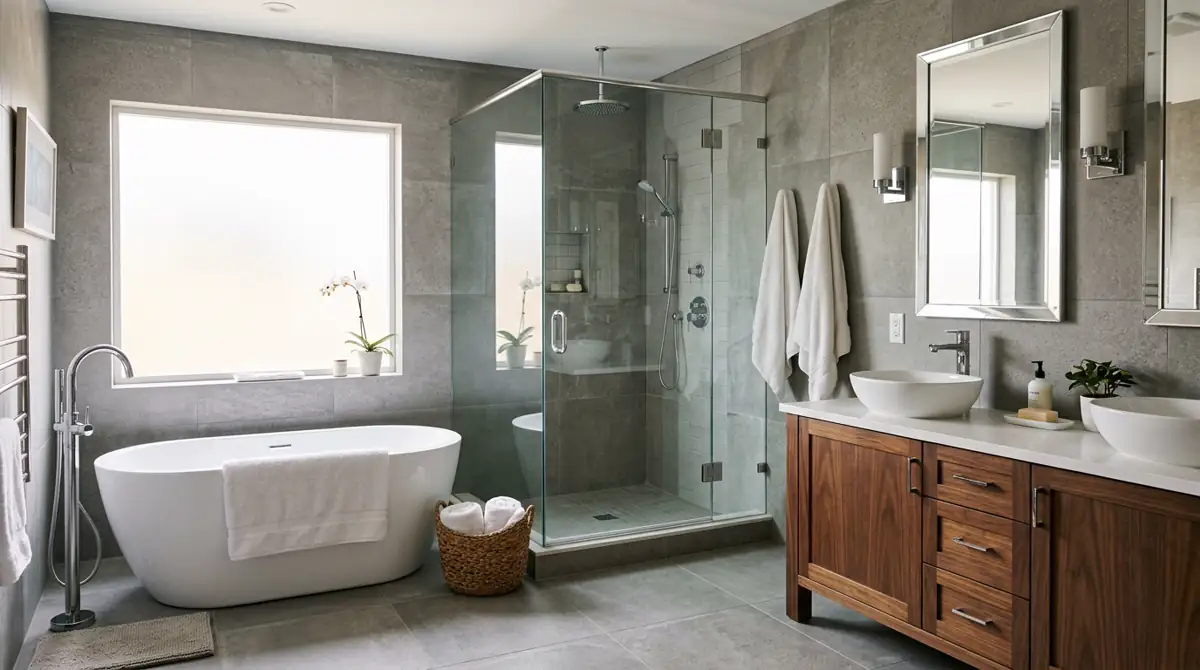
A high-end master bathroom renovation. The combination of a freestanding tub, frameless glass shower enclosure, and large-format tile is one of the most sought-after bathroom configurations in residential renovations today.
Bathrooms Are Expensive Per Square Foot — Here's Why
A bathroom renovation costs more per square foot than almost any other room in the house. A 50-square-foot bathroom remodel that runs $20,000 works out to $400 per square foot — a number that feels shocking until you understand what it includes.
First, nearly every surface in a bathroom is a finished surface. Floors, walls (at least in wet areas), ceiling — all require waterproofing, specialized installation, and skilled labor. Second, bathrooms concentrate multiple trades in a very small area: the plumber, the tile setter, the electrician, the carpenter. Coordinating their work in sequence takes time even when the physical space is tiny. Third, the materials — tile, fixtures, vanities, glass enclosures — cost significantly more per square foot than flooring and drywall in a standard room.
None of this means bathroom renovations aren't worth doing. They're consistently one of the best home improvement investments for daily quality of life and resale value. It just means you need to go in with realistic expectations rather than the numbers you saw on a renovation TV show.
Bathroom Renovation Costs by Scope
A half bath (toilet and sink only, no tub or shower) or a cosmetic refresh of an existing full bath without opening walls or moving plumbing.
- New vanity and faucet (keeping existing plumbing connections)
- Toilet replacement
- New light fixture and mirror
- Fresh paint on walls and ceiling
- New accessories (towel bars, toilet paper holder)
- Flooring refresh with peel-and-stick vinyl or basic floor tile
Good for: Guest baths, powder rooms, or bathrooms where the layout and fixtures work but the aesthetic is dated.
A full gut and replace of a standard full bathroom — tub/shower, toilet, vanity, flooring — keeping fixtures in their existing locations.
- New tub/shower surround (alcove tub or tub-shower combo)
- New tile floor and shower surround
- New vanity with sink and faucet
- New toilet
- New light bar or overhead fixture
- New mirror, accessories, and exhaust fan
- Backer board and waterproofing membrane in wet areas
- Drywall repair and fresh paint throughout
Good for: Secondary bathrooms, hall bathrooms, or primary baths in smaller homes where function is the priority.
A full master bathroom renovation with premium fixtures, a custom tile shower, and potentially a freestanding tub. May include layout changes.
- Walk-in custom tile shower with frameless glass enclosure
- Freestanding soaking tub with floor-mount faucet
- Double vanity (60–72 inches) with quartz countertop
- Large-format floor tile with heated floor mat
- Full wall tile in shower to ceiling
- Recessed niches in shower, bench, linear drain
- Updated electrical for heated floors and additional circuits
- Possible layout reconfiguration or closet expansion
Good for: Primary bathrooms in mid-to-high-value homes, buyers renovating for long-term enjoyment, or sellers in competitive markets.
Cost Breakdown by Category
Tile: The Biggest Variable in Any Bathroom
Tile is where homeowners make or break their bathroom budget — and where the widest price range exists for what appears to be "similar" product. The difference between a $2 per square foot ceramic tile and a $25 per square foot Italian porcelain isn't always visible in a magazine photo, but it shows up dramatically in the line item totals for a full bathroom.
| Tile Type | Material Cost/Sq Ft | Installed Cost/Sq Ft | Best Use |
|---|---|---|---|
| Basic ceramic | $1–$4 | $7–$14 | Budget floors and simple shower surrounds |
| Porcelain (standard) | $3–$8 | $10–$18 | Most residential applications; durable, low maintenance |
| Large-format porcelain (24"—24"+) | $5–$15 | $15–$28 | Modern master baths; fewer grout lines; requires flat substrate |
| Natural stone (travertine, slate) | $10–$25 | $20–$40 | Premium aesthetic; requires sealing; variable maintenance |
| Marble | $15–$50+ | $30–$70+ | Luxury applications; high maintenance; stains and etches |
| Mosaic / decorative accent | $10–$40+ | $20–$60+ | Shower niches, feature walls, floor patterns |
In an average full bathroom renovation, you might be tiling 80 to 150 square feet of floor and shower surround combined. At mid-range porcelain installed, that's $1,200 to $4,200 just in tile. In a master bathroom with a full custom shower and large-format floor tile, the tile and tile labor alone frequently runs $5,000 to $15,000.
The Shower: Often the Most Expensive Single Element
Nothing drives up a bathroom renovation budget faster than the shower specification. The difference between a standard alcove tub/shower combo and a custom walk-in tile shower with a frameless glass enclosure can be $8,000 to $20,000 — for that one element alone.
Here's how the shower options stack up on cost:
- Alcove tub/shower combo with acrylic surround: $1,500–$4,000 installed. Functional, easy to clean, fastest to install. The default for secondary bathrooms and budget projects.
- Tile shower in an existing alcove: $2,500–$6,000 installed. Same footprint as a tub, but tile walls and floor instead of an acrylic kit. Looks significantly better; takes longer and costs more.
- Walk-in custom tile shower (no tub): $4,000–$10,000 installed, depending on size and tile selection. Requires a proper waterproofing system (Schluter, RedGard, or similar), a linear or center drain, and professional tile work on multiple planes.
- Frameless glass enclosure: $1,500–$4,000 added on top of the shower itself. Frameless glass is cut to measure after tile is set — lead time of 2–4 weeks is typical.
- Steam shower: $5,000–$15,000 for the full system including the generator, special ceiling slope, sealed glass door, and steam-rated tile and grout throughout.
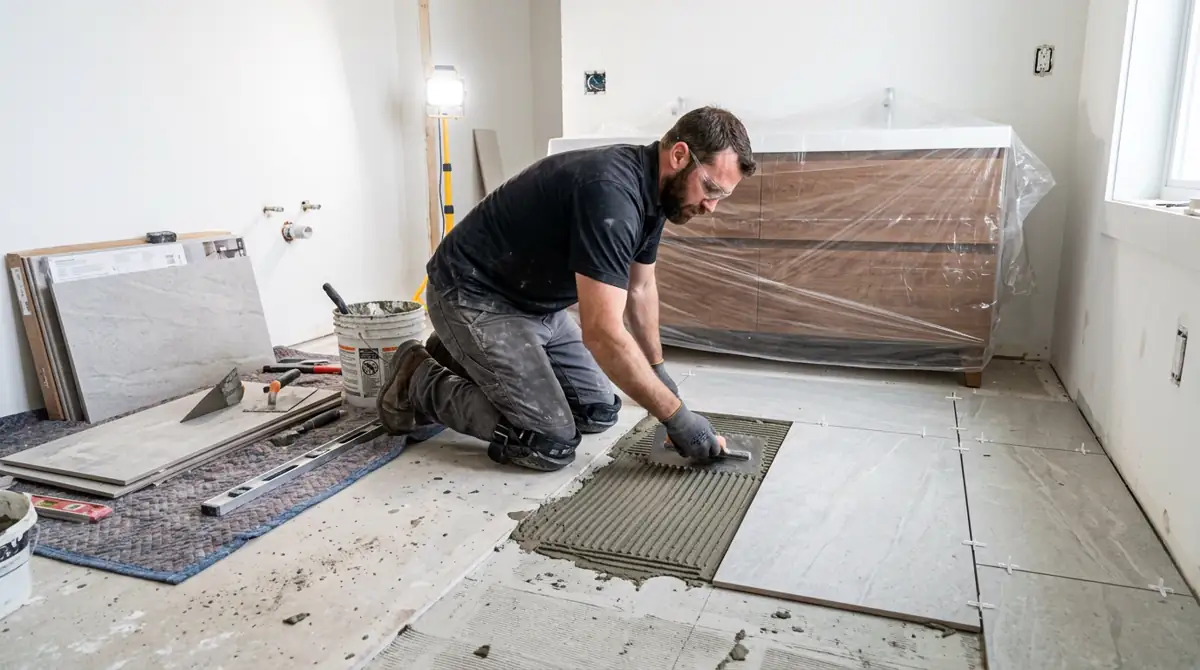
Large-format tile installation requires a perfectly flat substrate, full back-buttering of each tile, and careful lippage control. It's one of the most skill-dependent tasks in a bathroom renovation — this is not a beginner DIY project.
Vanity and Fixtures
The vanity is the visual anchor of most bathrooms and has a wide cost range depending on whether you go with a stock unit, semi-custom, or custom-built cabinet with a separate countertop and undermount sinks.
- Stock vanity (24–36 inch, single sink): $300–$1,200 for the cabinet and top together. Available at home centers; limited style selection; works fine for secondary bathrooms.
- Mid-range vanity (48–60 inch, single or double): $800–$3,000 for cabinet and top. Better construction, more style choices, floating options available.
- Semi-custom or furniture-style vanity (60–72 inch, double): $2,500–$7,000. Custom-depth options, specialty finishes, separate countertop with undermount sinks.
- Fully custom vanity: $5,000–$15,000+. Built by a cabinet maker; matches existing millwork; any dimensions, any finish.
Faucets range from $80 for a decent builder-grade unit to $500–$1,500+ for designer or precision fixtures. Toilets range from $150 for a standard two-piece to $1,000+ for a comfort-height elongated model with soft-close seat. The Kohler, TOTO, and American Standard mid-range lines ($250–$600) hit the sweet spot of quality and value for most projects.
Labor: Where Bathroom Costs Are Often Underestimated
Labor typically represents 40 to 50 percent of a bathroom renovation budget — higher than in almost any other home renovation category. The reason is that tile work is slow, precise, skilled work that can't be rushed. A tile setter installing large-format tile in a custom shower may set as few as 30 to 50 square feet per day when accounting for layout, cutting, and leveling.
Typical labor costs for bathroom renovation trades in 2026:
- Tile setter: $8–$15 per square foot labor-only for standard tile; $15–$30 per square foot for large format, mosaic, or complex patterns
- Plumber: $75–$150 per hour; rough-in for a full bath typically runs $1,500–$4,000 in labor
- Electrician: $75–$150 per hour; bathroom electrical typically runs $500–$2,000 depending on scope
- General contractor overhead: 15–25% of total project cost for coordination, scheduling, and project management
The Waterproofing You Cannot Skip
The number-one cause of expensive bathroom failures — mold behind tile, rotted subfloor, structural water damage — is inadequate waterproofing in wet areas. This is not a place to cut costs, and it's an area where the cheapest contractor bids are most likely cutting corners.
Shower floors and walls require a continuous waterproofing membrane — not just cement backer board. Modern systems like Schluter KERDI, USG Durock, and RedGard applied directly to the backer provide a genuinely waterproof system behind the tile. The membrane, properly installed with sealed corners and penetrations, is what keeps water out of the wall assembly for the life of the tile installation.
Ask any contractor bidding your bathroom renovation what waterproofing system they use in the shower. If the answer is just "backer board," ask them to specify a membrane system. It adds $200–$600 to material cost and protects a $5,000–$15,000 tile installation.
What Moves the Needle Most on Bathroom Cost
If you're trying to control your bathroom renovation budget, these are the decisions that matter most:
- Keep fixtures in their current locations. Moving the toilet or shower even a few feet requires re-routing drain lines — potentially through a concrete slab — and adds $2,000–$8,000 or more to plumbing cost alone.
- Tile selection is a massive lever. The difference between $3-per-square-foot tile and $15-per-square-foot tile across a full bathroom and shower surround can easily be $3,000 to $8,000 in material alone. Choose tile that looks excellent at mid-range pricing rather than premium-tier.
- Shower type drives cost more than anything else. A frameless glass walk-in tile shower costs $10,000–$20,000 more than a standard alcove tub/shower. If budget is a concern and you're renovating a secondary bath, keep the tub.
- Freestanding tub math. A freestanding soaking tub ($800–$3,000) also requires a floor-mount faucet ($400–$1,500), a tub drain and overflow, and potentially a hot water line extension. Budget $3,000–$6,000 total for the full freestanding tub installation.
Getting Accurate Bids for Your Bathroom
Bathroom renovation bids from different contractors can vary by 50 to 100 percent for the same scope. That's not necessarily because one contractor is dishonest — it often means they've made very different assumptions about what's included. To get bids you can actually compare:
- Provide a written scope — "remove existing tub/shower, install tile shower, keep existing vanity location" is specific enough to get comparable bids
- Specify the tile you've selected or a cost-per-square-foot allowance for tile material
- Specify the vanity and toilet model if you've selected them
- Ask whether plumbing and electrical are included or subcontracted separately
- Ask what waterproofing system they use in the shower
- Ask whether the price includes drywall repair and painting after tile work is complete
Planning a Bigger Renovation?
Our complete home renovation budgeting guide covers contingency planning, contractor bids, and budget management strategies that work across any project type.
Frequently Asked Questions
How much does a bathroom remodel cost?
In 2026: powder room refresh $2,500–$8,000; mid-range full bathroom gut renovation $10,000–$25,000; master bathroom renovation $25,000–$60,000; luxury master bath $60,000+. Labor, tile selection, shower type, and fixture quality are the biggest variables in where your project lands.
What is the most expensive part of a bathroom remodel?
Labor is usually the largest overall cost (40–50% of total), but the custom tile shower is typically the most expensive single element. A full walk-in tile shower with frameless glass — materials plus labor — commonly runs $8,000–$20,000 alone.
How long does a bathroom remodel take?
Powder room refresh: 3–7 days. Standard full bathroom: 2–4 weeks. Master bath gut renovation: 4–8 weeks. Tile curing and glass enclosure fabrication lead times are the primary schedule constraints that can't be compressed regardless of crew size.
Does a bathroom remodel add value?
Consistently yes. Mid-range bathroom remodels return 55–70% of their cost at resale. Master bathroom renovations in homes with outdated primary baths can return more because buyers directly compare against market standards. Adding a bathroom where none existed returns 50–60% and can make a home significantly more competitive in its price range.