Kitchen & Interior
How Much Does a Kitchen Renovation Cost? (Complete 2026 Guide)
Let's be honest — the kitchen is the room that sells a house. It's also the room that can completely derail a renovation budget if you don't go in with a clear picture of what things actually cost. I've managed kitchen renovations ranging from $8,000 refreshes to $140,000 custom gut jobs, and the homeowners who come out happy are almost always the ones who understood the cost breakdown before the first demo nail was pulled. This guide gives you exactly that.
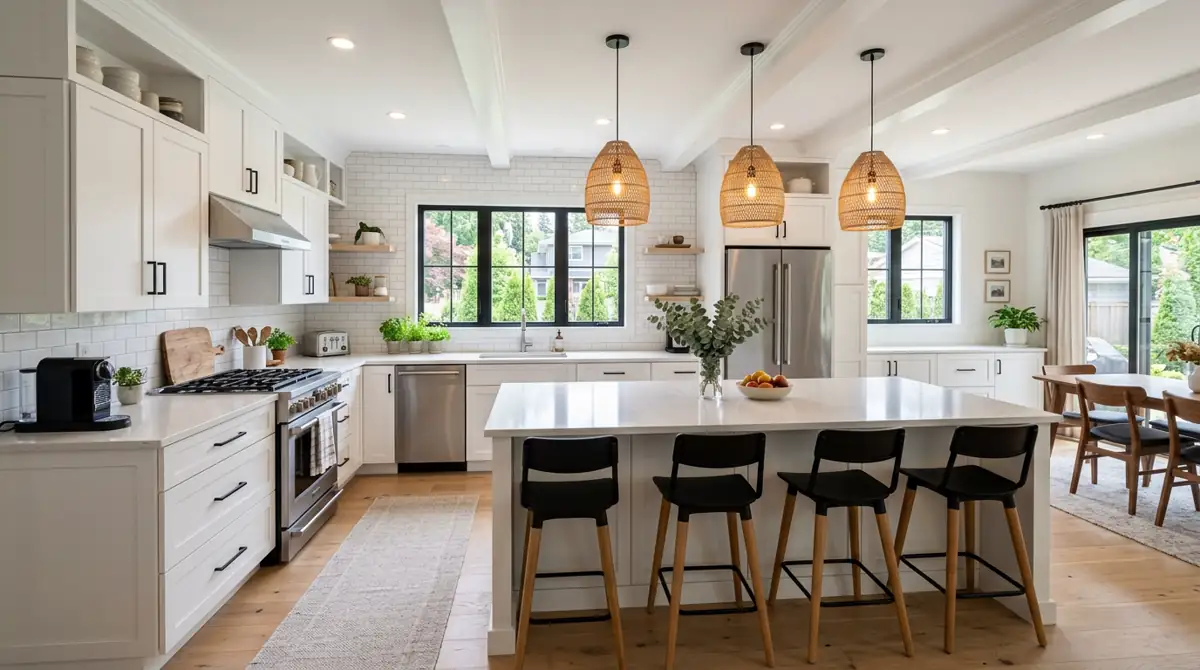
A mid-to-high-range kitchen renovation. White shaker cabinets, quartz countertops, and stainless appliances represent the most popular combination in American residential renovations today.
Why Kitchen Renovation Costs Vary So Wildly
You've probably seen the "$10,000 to $100,000" range cited online and found it completely unhelpful. The reason the range is so wide isn't vagueness — it's because kitchen renovations genuinely span an enormous scope of work. A "kitchen renovation" can mean painting the cabinets and swapping hardware, or it can mean removing a load-bearing wall, relocating the plumbing stack, adding radiant floor heat, and installing custom cabinetry with stone countertops throughout. Those are fundamentally different projects that happen to share a name.
The real cost drivers come down to five things: the size of your kitchen, whether you're changing the layout, your cabinet choice, your countertop material, and your appliance selections. Everything else — tile, fixtures, lighting, hardware — matters, but those five categories determine roughly 80 percent of where your budget lands.
Kitchen Renovation Costs by Tier
This is the cosmetic-only lane — no layout changes, no structural work, no appliance replacement. You're updating the look without touching the bones of the kitchen.
- Cabinet painting or refacing (keeping existing box structure)
- New hardware throughout
- Laminate or budget-tier countertops
- Tile backsplash installation
- New light fixtures on existing circuits
- Faucet and sink replacement
- Fresh paint on walls and ceiling
Who this works for: Homeowners preparing to sell, renters doing landlord-approved updates, or anyone with solid cabinets in good structural shape who just wants a visual refresh.
This is where most American kitchen renovations land. Everything comes out and goes back in new — same layout, same footprint, but fully updated materials and finishes.
- New semi-custom cabinets (stock or semi-custom, not fully custom)
- Quartz or granite countertops
- Mid-range stainless steel appliances
- Porcelain or ceramic tile flooring
- Updated electrical outlets and under-cabinet lighting
- New sink, faucet, and garbage disposal
- Tile backsplash with professional installation
- Recessed lighting or updated ceiling fixtures
Who this works for: Homeowners planning to stay 5–10+ years, those whose kitchens are functionally outdated, or buyers who purchased a home knowing the kitchen needed full replacement.
Custom everything, layout changes, structural modifications, and luxury-tier finishes throughout. No compromise on materials or execution.
- Custom-built cabinetry (face-frame or frameless)
- Natural stone countertops (marble, quartzite, leathered granite)
- Professional-grade appliances (Wolf, Sub-Zero, Miele, Thermador)
- Radiant floor heating
- Layout reconfiguration — island additions, wall removal
- Full electrical panel upgrade or subpanel addition
- Plumbing relocation
- Custom range hood and millwork
Who this works for: Long-term homeowners building their forever home, buyers in high-value markets, or those renovating for luxury resale.
The Biggest Cost Categories — Broken Down
Cabinets: 30–40% of your budget
Cabinets are almost always the largest single line item in a kitchen renovation, and they're where the widest quality range exists. The three tiers are stock, semi-custom, and custom — and the differences matter more than most homeowners realize before they're standing in a showroom trying to decide.
Stock cabinets come in fixed sizes and configurations, are available at big-box retailers, and are typically the least expensive option. Expect to pay $3,000 to $8,000 in cabinets for an average kitchen. They're a reasonable choice for budget projects but have limited size flexibility and fewer finish options.
Semi-custom cabinets are built to order in more sizes and configurations than stock, with more door style and finish choices. For an average kitchen, semi-custom typically runs $8,000 to $20,000 in cabinet cost alone, before installation. This is where most mid-range renovations land.
Custom cabinets are built by a cabinet maker to your exact specifications — size, style, material, interior features. They start around $15,000 for a smaller kitchen and can easily exceed $40,000 or $50,000 in larger kitchens with complex layouts. The result is genuinely different from anything you'll find at a showroom.
Cabinet installation labor typically adds 15–25% on top of the cabinet cost, and new hardware runs $3 to $15 per piece depending on quality and quantity.
Countertops: 10–20% of your budget
Countertop material choice has an enormous impact on both cost and the overall impression of the kitchen. Here's a quick breakdown of what different materials cost installed:
| Material | Cost per Sq Ft (Installed) | Notes |
|---|---|---|
| Laminate (Formica-style) | $15–$40 | Most budget-friendly; improved dramatically in recent years; not heat-proof |
| Butcher block | $40–$100 | Warm, popular for islands; requires oiling and careful maintenance near sinks |
| Ceramic / porcelain tile | $25–$60 | Grout lines are a maintenance burden; durable but dated look in many kitchens |
| Granite | $50–$150 | Natural stone; durable; requires annual sealing; huge variation in price by slab origin |
| Quartz (engineered) | $60–$150 | Most popular choice today; non-porous, no sealing needed; consistent appearance |
| Marble | $80–$200+ | Stunning aesthetic; requires sealing and care; etches and stains if not maintained |
| Quartzite | $90–$200+ | Natural stone with marble appearance but harder; premium pricing for premium slabs |
For an average kitchen of 30 to 50 square feet of counter space, quartz countertops typically run $2,000 to $6,000 installed, making them the most popular choice at the mid-range price point.
Appliances: 15–25% of your budget
Appliance cost is the most controllable major line item in a kitchen renovation — you can spend $3,500 on a full suite of basic stainless or $25,000 on professional-grade equipment. The functional difference between the two is real but rarely matters for most home cooks.
A complete appliance package (range/cooktop, dishwasher, refrigerator, microwave or hood) at each level typically costs:
- Budget-tier brands (Frigidaire, Amana, GE base): $2,500–$5,000 for a full suite
- Mid-range brands (GE Profile, LG, Samsung, Bosch): $5,000–$12,000 for a full suite
- Premium brands (Café, KitchenAid, Jenn-Air): $10,000–$20,000 for a full suite
- Professional-grade (Wolf, Sub-Zero, Thermador, Miele): $20,000–$50,000+ for a full suite
One important note: built-in refrigerators and professional ranges require cabinetry to be designed and built around them — you can't easily swap to these appliances in a kitchen built for standard-depth models. If you want professional appliances, plan for them at the beginning of the project, not as an afterthought.
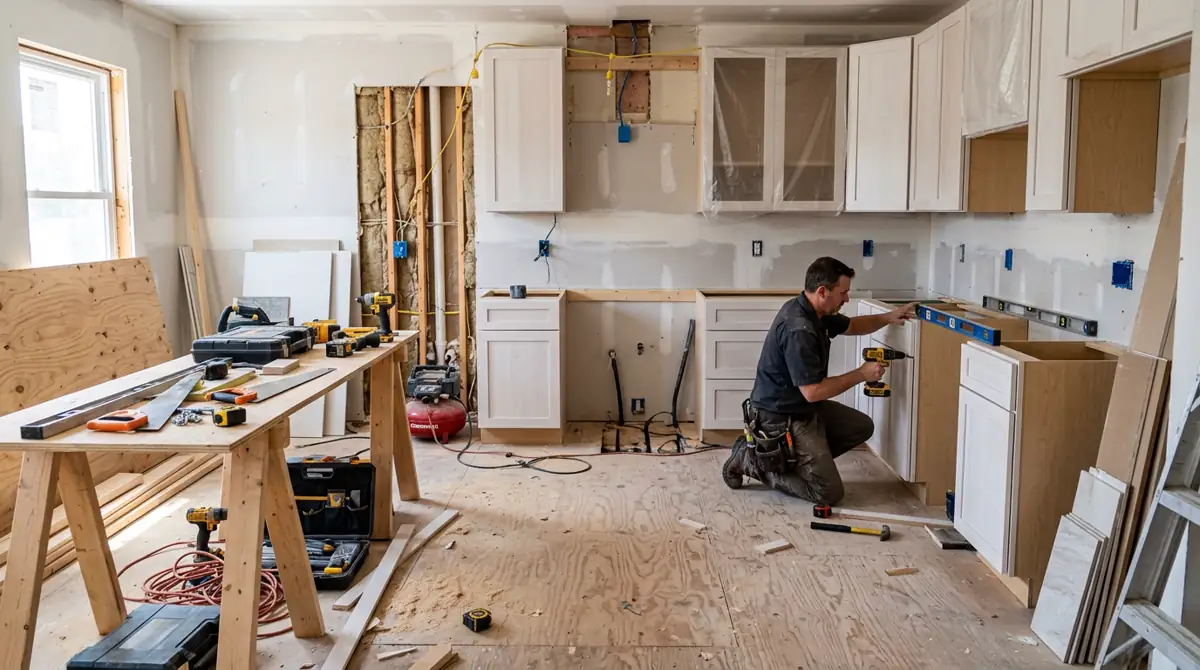
The mid-renovation phase — cabinets going in, electrical and plumbing rough-in complete, countertops and backsplash still to come. This is where experienced project management makes the biggest difference in staying on schedule.
Labor: 20–35% of your budget
Labor is the cost that surprises homeowners most, and the one that's hardest to shop around. A kitchen renovation typically involves multiple trades: a general contractor or kitchen remodeler, a plumber (for sink and possibly dishwasher), an electrician (almost always — kitchens require dedicated circuits for major appliances), and potentially a tile setter, a flooring installer, and a painter. Each trade brings their hourly rate, and in most urban and suburban markets those rates have risen significantly since 2022.
For a mid-range kitchen renovation, labor typically runs $8,000 to $18,000 or more, depending on the scope and your market. In high cost-of-living areas like coastal cities, labor can represent 35–40% of the total project budget.
Layout Changes: The Hidden Cost Multiplier
If your renovation keeps the same layout — appliances, sink, and work triangle in the same positions — you avoid the most expensive work a kitchen renovation can require. The moment you move a sink, relocate a gas line, or add an island that requires electrical, the cost escalates quickly.
Moving a kitchen sink requires a licensed plumber to extend or reroute drain lines, which can run $1,500 to $4,000 or more depending on how far the new location is from the existing stack. Moving a gas range requires a licensed gas fitter. Adding circuits for new appliances requires a licensed electrician and typically a permit. Opening walls to move these utilities also means repairing drywall, repainting, and potentially refinishing flooring where demo was done.
What to Splurge On vs. Where to Save
Every budget has a limit. Knowing where to invest and where to trim intelligently makes the difference between a kitchen that feels premium and one that has visible compromises.
Worth every dollar
- Cabinet quality — You open and close these dozens of times a day. Soft-close hinges, quality drawer glides, and solid box construction are worth it for the long-term experience.
- Countertop quality — This is what you see and touch most. Quartz or natural stone pays off in daily satisfaction and resale appeal.
- Lighting — Under-cabinet task lighting, recessed overhead lighting, and a statement pendant over the island transform how the kitchen feels at night. Don't let this be an afterthought.
- Ventilation — A properly sized range hood vented to the exterior keeps your home cleaner and eliminates cooking smells. Recirculating hoods are a poor substitute.
Where you can reasonably save
- Appliance brands — Mid-range appliances from Bosch, LG, and GE Profile perform excellently for most home cooks. Professional-grade is a lifestyle choice, not a functional necessity for the majority of households.
- Backsplash — Subway tile is affordable, timeless, and looks great. You don't need imported handmade tile to have a beautiful backsplash.
- Cabinet hardware — You can find beautiful pulls and knobs for $3 to $6 each. The $25-per-piece version looks great in a showroom but adds up to thousands more in a large kitchen for minimal visual return.
- Flooring — Luxury vinyl plank in a kitchen is practical, durable, and looks very good. Saving on flooring frees up budget for cabinets and countertops where it shows more.
How to Get Accurate Bids
The best kitchen renovation bids come from contractors who specialize in kitchens — not general handymen and not the cheapest name you found online. Kitchen renovations require coordination across multiple trades, and an experienced kitchen remodeler manages that coordination so you don't have to.
Before you contact contractors, do this homework:
- Know your kitchen's dimensions and sketch the existing layout
- Decide whether you're changing the layout or keeping it the same
- Choose a cabinet tier (stock, semi-custom, or custom) so contractors are bidding the same scope
- Have a rough appliance selection in mind (basic, mid-range, or premium)
- Define what's in and out of scope — flooring, painting, window replacement if applicable
Get at least three bids. Bids that are more than 20% below the others deserve scrutiny — ask what's different. Bids should specify the cabinet brand and line, countertop material and thickness, and which trades are subcontracted vs. self-performed.
Ready to Plan Your Kitchen Budget?
Read our full home renovation budgeting guide for strategies that keep projects on track from first quote to final walkthrough.
Frequently Asked Questions
What is the average cost of a kitchen renovation?
In 2026, most American homeowners spend $20,000 to $50,000 on a mid-range kitchen renovation — new cabinets, countertops, appliances, and updated finishes without layout changes. Budget refreshes (painting, hardware, minor updates) run $5,000 to $15,000. Full gut renovations with custom finishes typically cost $60,000 to $130,000 or more.
What is the most expensive part of a kitchen renovation?
Cabinets are consistently the largest line item, representing 30–40% of most kitchen renovation budgets. Semi-custom or custom cabinetry for a full kitchen easily runs $10,000 to $40,000 in materials alone, before installation labor.
How long does a kitchen renovation take?
A minor refresh takes 1–2 weeks. A standard mid-range renovation (same layout, full replacement) typically runs 4–8 weeks. A full gut renovation with layout changes and custom cabinetry takes 10–16 weeks or more — custom cabinet lead times alone are often 6–12 weeks.
Does a kitchen renovation add value?
Yes — consistently one of the highest-ROI renovations. A mid-range kitchen remodel typically returns 50–70% of its cost at resale. Minor refreshes return even more — often 70–85%. The kitchen is the most scrutinized room during home sales, so a dated or dysfunctional kitchen actively hurts your listing price.