Masonry & Concrete
Cinder Block vs Concrete Block vs CMU: What's Actually the Difference?
Walk into any hardware store, lumber yard, or building supply house in America and ask for a "cinder block." You'll get pointed toward a pallet of hollow gray masonry blocks without anyone batting an eye. Ask a structural engineer to specify "cinder blocks" for your retaining wall, and they'll probably correct you before putting anything on paper. The terminology around these three terms — cinder block, concrete block, and CMU — is genuinely confusing, partly because everyday language and technical language have drifted apart over the past 70 years. This guide sets the record straight.
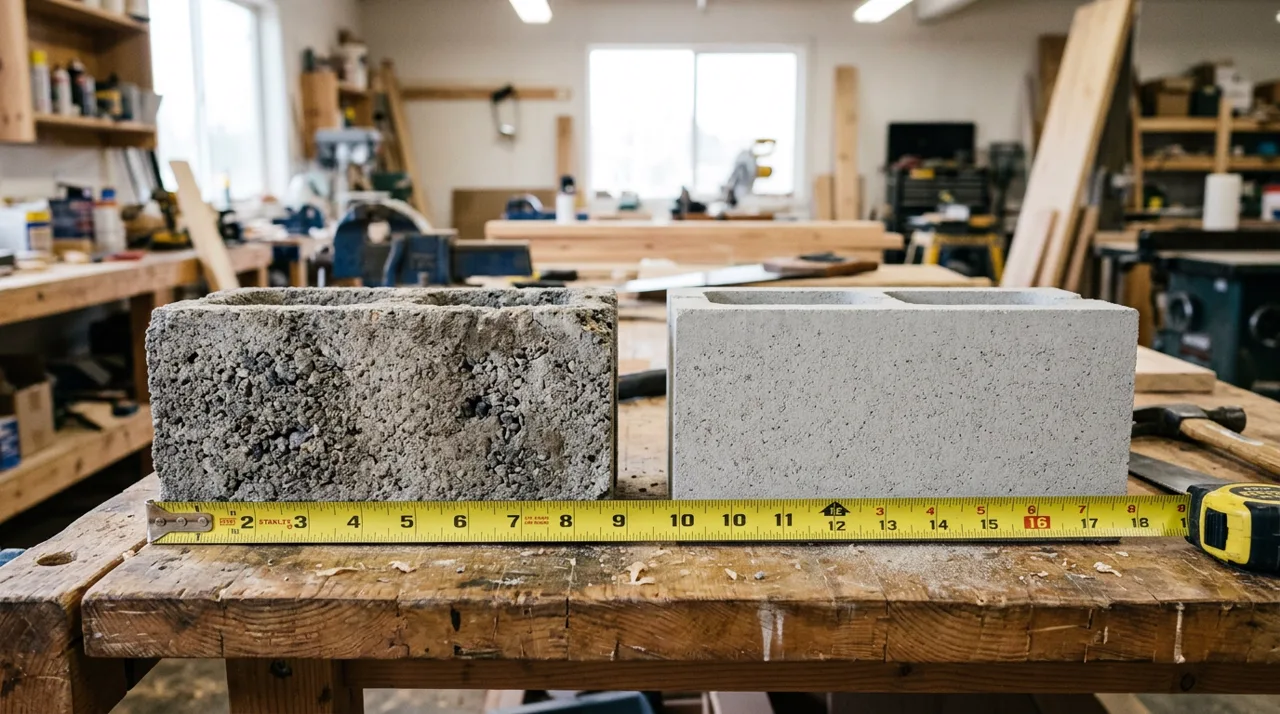
The textural difference between a true cinder block (left) and a modern concrete CMU block (right) is visible up close — cinder blocks have a coarser, darker, more porous surface due to the coal ash aggregate.
Where Did the Term "Cinder Block" Even Come From?
To understand the confusion, you have to go back about a century. In the early 1900s, coal was the dominant fuel for heating, power generation, and industrial processes across America. Burning coal produces a byproduct called cinder — the ash and clinker left behind after combustion. This cinder was abundant, cheap, and — it turned out — made a reasonably good lightweight aggregate for concrete block manufacturing.
The first concrete masonry units made with cinder aggregate became widely popular in the 1920s and 1930s. They were lighter than blocks made with gravel or stone aggregate, which made them easier to lay by hand. They were also cheap, since cinder was essentially industrial waste. By mid-century, cinder blocks were everywhere — basements, garages, warehouses, foundations — and the name "cinder block" became synonymous with the hollow gray masonry block in the American building vocabulary.
The problem was that real cinder aggregate had significant limitations. It was porous, inconsistent in quality, and produced blocks with lower compressive strength than gravel-aggregate concrete. Coal cinder also had a tendency to absorb moisture and, in some cases, contained sulfur compounds that caused long-term durability problems. As building codes became more rigorous and engineered standards more demanding, the industry gradually shifted away from coal cinder toward higher-quality aggregates.
By the 1970s and 1980s, most block manufacturers had switched to gravel, crushed stone, expanded shale, expanded clay, or slag as their primary aggregates. The coal-fired power plants that once supplied abundant cinder have also declined dramatically. True cinder blocks — made with coal combustion aggregate as the primary filler — are rarely if ever manufactured today. But the name stuck in everyday language long after the product changed.
What Is a Concrete Block, Technically?
A concrete block is any hollow or solid block manufactured from Portland cement, water, and aggregate. The aggregate can be almost anything: natural sand and gravel, crushed limestone, expanded shale (used for lightweight blocks), expanded clay, blast furnace slag, or recycled materials. What defines a concrete block is the Portland cement binder — the same fundamental chemistry that makes concrete concrete.
Modern concrete blocks are manufactured under strict quality controls to meet ASTM (American Society for Testing and Materials) standards — primarily ASTM C90, which specifies minimum compressive strength, dimensional tolerances, moisture absorption limits, and fire resistance for load-bearing concrete masonry units. A block meeting ASTM C90 Grade N must achieve a minimum net-area compressive strength of 1,900 psi.
For reference, traditional cinder blocks typically achieved somewhere between 700 and 1,200 psi compressive strength — well below the modern standard. This is the most practically important difference between the old cinder block era and today's concrete blocks.
So What Is a CMU?
CMU stands for Concrete Masonry Unit. It is the formal, code-sanctioned term that architects, engineers, and building officials use to refer to what most people call a concrete block. It's a category term — like "lumber" or "steel" — that covers the full range of hollow and solid concrete masonry products regardless of their specific aggregate composition.
When you see "CMU" in a set of architectural drawings, a structural specification, or a building code reference, it means concrete masonry units manufactured to current ASTM standards. The term is deliberately neutral about aggregate type, which is practical because the properties that matter for design — compressive strength, dimensional accuracy, weight class, fire rating — are specified separately regardless of how the block achieved them.
In everyday use at a lumber yard or hardware store, CMU, concrete block, and cinder block all refer to the same product: the standard hollow gray masonry block. The person behind the counter doesn't care what you call it. But if you're specifying materials for a permit-required construction project, "ASTM C90 CMU" is the phrase that appears in construction documents for a reason — it specifies the exact standard the block must meet.
Cinder Block
Made with coal ash (cinder) aggregate. Lighter but weaker — 700 to 1,200 psi. Rarely manufactured today. Common in pre-1970s construction.
Concrete Block
Made with Portland cement + modern aggregates (gravel, shale, slag). Strong — 1,900+ psi (ASTM C90). What you actually buy today.
CMU
Concrete Masonry Unit — the official engineering/code term. Covers all concrete blocks meeting ASTM standards. Used in specs and plans.
The Key Differences: A Side-by-Side Comparison
| Property | True Cinder Block | Modern Concrete Block / CMU |
|---|---|---|
| Primary Aggregate | Coal cinder / coal ash | Gravel, shale, slag, or lightweight aggregate |
| Compressive Strength | 700–1,200 psi typical | 1,900–3,000+ psi (ASTM C90) |
| Weight (8x8x16) | 25–35 lbs | 28–43 lbs (lightweight to normal-wt) |
| Water Absorption | Higher (more porous) | Lower — controlled by ASTM limits |
| Surface Texture | Coarser, darker | Smoother, more uniform gray |
| Durability | Lower — prone to spalling/crumbling | High when manufactured to ASTM standards |
| Availability | Rarely manufactured today | Universally available |
| Cost | N/A (historic) | $2–$4 per block (standard 8x8x16) |
| Code Compliance | Does not meet ASTM C90 | Meets ASTM C90 Grade N when specified |
| Best Use | Non-structural only (if using old stock) | Load-bearing walls, foundations, retaining walls |
Five Common Myths About These Blocks — Busted
"Cinder blocks and concrete blocks are the same thing." — Technically false, though practically speaking, what you'll find at a store today is always a concrete block. True cinder blocks used coal ash aggregate and are rarely made anymore. The distinction matters when dealing with old construction from the pre-1970s era.
"Cinder blocks are weaker so they're cheaper and fine for garden walls." — If you're buying blocks today, you're buying concrete CMU blocks — not cinder blocks. You don't actually have access to true cinder blocks unless you're salvaging old construction materials. The blocks at your hardware store meet modern standards regardless of what you call them at the counter.
"CMU just means a specific size of block." — No. CMU is a category term covering all concrete masonry units — 4-inch, 6-inch, 8-inch, 10-inch, 12-inch, half blocks, bond beam blocks, corner blocks, and more. It describes the product type, not a specific size.
"Old cinder blocks in my basement are fine to leave." — Possibly, but not automatically. Inspect them carefully. Cinder blocks from the mid-20th century may be crumbling, absorbing water excessively, or displaying spalling and efflorescence. If they're showing active deterioration, they should be evaluated by a structural engineer — especially in load-bearing or below-grade applications.
"Fly ash in modern CMU makes it similar to old cinder blocks." — Fly ash (a byproduct of modern coal combustion) is sometimes used as a partial cement replacement in modern CMU manufacturing. But fly ash used this way is a finely ground pozzolanic material that can improve concrete properties — it's completely different from the coarse cinder aggregate used in old-style cinder blocks.
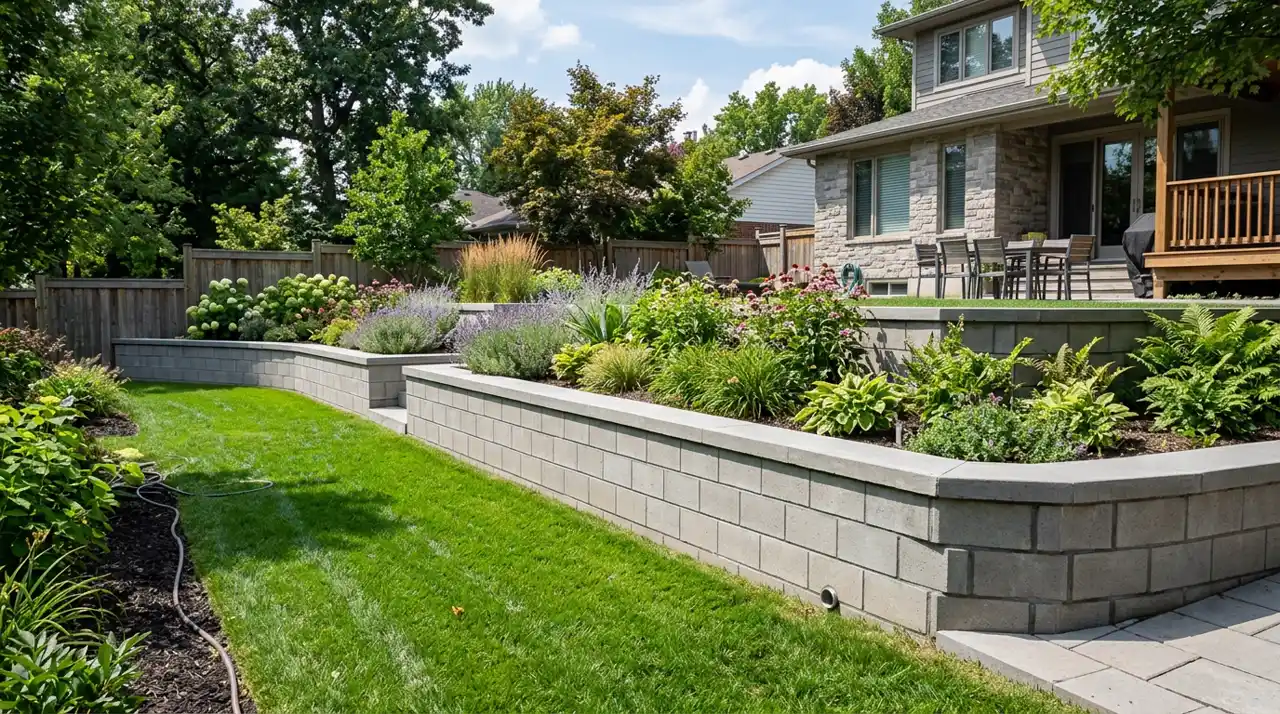
Today's CMU blocks deliver durability and structural performance that true cinder blocks never could. A properly designed and built CMU retaining wall can last 50 to 100 years with minimal maintenance.
When Does the Distinction Actually Matter for Your Project?
For most homeowners buying new blocks for a garden wall, raised bed, or small retaining wall, the cinder/concrete/CMU terminology debate is largely academic. You're going to buy whatever hollow gray block is stacked on a pallet at your local building supply, and that product will be a modern concrete CMU that meets current standards. Call it whatever you want at the counter.
The distinction starts to matter in these real-world situations:
Old construction assessment. If you're buying a home built before 1970 and the foundation or basement walls are "cinder block," that actually means something structurally. True cinder block walls from the 1940s, 50s, and 60s may have lower structural capacity, higher moisture absorption, and more deterioration risk than a modern CMU wall. A structural engineer should assess them rather than assuming they're equivalent to new construction.
Salvaged materials. Some people salvage old blocks from demolition sites for DIY projects. If those blocks predate the 1970s, they may be true cinder blocks. For any structural application — retaining walls, foundation elements, load-bearing walls — don't use salvaged blocks of unknown age, manufacturer, or test history. The material savings don't justify the structural uncertainty.
Permit-required projects. When pulling a permit for a retaining wall, foundation, or structural masonry project, your engineer's drawings will specify "ASTM C90 CMU." This tells the block manufacturer, the supplier, and the building inspector exactly what standard the block must meet. If you hand the contractor a spec sheet that says "cinder block," a good contractor will know you mean CMU; a less careful one might cause confusion.
Insurance and mortgage inspections. In older homes, a home inspector noting "cinder block foundation" in their report may raise questions about durability and moisture management. Understanding the difference — and being able to demonstrate that the blocks are in good condition — can matter in real estate transactions.
Strength Comparison in Practice: What 1,900 psi vs 1,000 psi Means
The compressive strength difference between a true cinder block (roughly 700–1,200 psi) and a modern ASTM C90 CMU (minimum 1,900 psi) sounds abstract unless you put it in context.
For a typical 8-foot tall load-bearing wall built from 8-inch CMU, the design load capacity depends on both the block strength and the level of reinforcement and grouting. An unreinforced 8-inch CMU wall using 1,900 psi blocks can carry substantial axial loads that a cinder block wall of the same dimensions simply cannot safely support without additional engineering.
In retaining wall applications, the difference becomes even more pronounced because retaining walls experience both vertical load from the wall's own weight and horizontal load from soil pressure. The higher compressive strength of modern CMU, combined with rebar and grout fill in the cores, gives engineers the numbers they need to certify the wall's safety. True cinder blocks would require significantly more engineering reinforcement to achieve comparable results — if they could meet code at all.
For a simple non-structural application like a garden bed border or a low decorative wall under 2 feet tall with no retained soil, the strength difference is irrelevant — either product would be vastly overbuilt for that use. But once you start building retaining walls with meaningful soil pressure, load-bearing walls, or any structure that a person could be injured by if it failed, modern ASTM C90 CMU is the only appropriate choice.
Lightweight vs. Normal Weight CMU: Another Distinction People Confuse
Separate from the cinder/concrete debate is the question of lightweight vs. normal weight CMU — a distinction that's actually relevant when buying today's blocks. Both are modern concrete products meeting ASTM C90, but they use different aggregates to achieve different weights.
Normal weight CMU uses conventional sand and gravel aggregate. An 8x8x16 normal-weight block weighs approximately 38–43 lbs. These blocks have better compressive strength, better sound isolation, and are preferred for load-bearing structural walls and fire-rated applications.
Lightweight CMU uses expanded shale, expanded clay, or expanded slag as aggregate. An 8x8x16 lightweight block weighs approximately 28–33 lbs — about 25% less. They're easier to lift and lay (less mason fatigue over a full day), easier on footings due to reduced dead load, and often preferred for non-load-bearing and partition wall applications.
Ironically, the fact that cinder blocks were lighter than traditional gravel-aggregate blocks is what made them popular historically — and the modern lightweight CMU category fills that same practical niche today, but with controlled quality and predictable performance that old cinder blocks never guaranteed.
What to Specify for Your Project in 2026
Here's the practical guide by project type:
Load-bearing wall or foundation: Specify ASTM C90 Grade N CMU, 8-inch width minimum (12-inch for heavily loaded commercial applications), normal weight unless your engineer specifies otherwise. Never use salvaged or unknown-age blocks.
Retaining wall (2–4 feet): ASTM C90 Grade N CMU, 8-inch width, reinforced with #4 or #5 vertical rebar at 32–48 inches on center, grouted cores, bond beam at top. Lightweight CMU is acceptable if structurally verified.
Retaining wall (4+ feet): Requires a structural engineer regardless of what you call the block. They will specify exactly what you need based on soil conditions, surcharge loads, seismic zone, and drainage design.
Garden wall, decorative low wall (under 2 feet, no retained soil): Any available concrete CMU works fine. Lightweight blocks will be easier to work with. You don't need to stress about grade or specification.
Garage or workshop wall (non-load-bearing): Standard ASTM C90 CMU, 8-inch width, reinforcement as required by local code. This is the most common backyard masonry project and standard block is perfectly appropriate.
A Note on Aesthetics: Why Cinder Blocks Have a Certain Look
If you've ever seen a mid-century garage or an old factory building with rough, slightly grainy-looking block walls, you were probably looking at true cinder blocks. The coarser texture and slightly darker, more varied appearance comes directly from the coal ash aggregate. Modern CMU blocks tend to be smoother, more uniformly gray, and more consistent in appearance — which is partly why architects sometimes prefer the textural character of older masonry for certain aesthetic projects.
For projects where the aesthetic of rough, industrial masonry is desired, split-face CMU is the modern solution — it's standard concrete CMU that's been mechanically fractured to create a rough, irregular surface during manufacturing. You get the textural appeal without the structural compromises of actual historical cinder blocks.
Building a CMU Wall? Start With Our Step-by-Step Guide
From footing layout to cap course — everything you need to build a solid, plumb CMU wall the right way.
Frequently Asked Questions
Is a cinder block the same as a concrete block?
Not technically. A true cinder block uses coal ash as its aggregate, making it lighter but weaker than a modern concrete block. Most people use the terms interchangeably, but what you'll find at any store today is a concrete block (CMU), not a true cinder block.
What does CMU stand for?
CMU stands for Concrete Masonry Unit. It is the official architectural and engineering term for what most people call a concrete block or cinder block. CMU is used in construction documents, building codes, and professional specifications.
Are cinder blocks still made today?
True cinder blocks made with coal ash aggregate are rarely manufactured today. The decline of coal-fired power plants reduced the supply of cinder aggregate. Blocks sold today are almost universally modern concrete CMU products, not traditional cinder blocks.
Which is stronger — cinder block or concrete block?
Modern concrete CMU blocks are significantly stronger. A standard ASTM C90 concrete CMU achieves a minimum 1,900 psi compressive strength. Traditional cinder blocks typically achieved 700–1,200 psi — less than half the strength of today's product.
Can I use old cinder blocks for a retaining wall?
Not recommended for structural retaining walls. Old cinder blocks have lower compressive strength, higher water absorption, and unknown condition. For any retaining wall over 2 feet high, use modern ASTM C90 CMU blocks that meet code-required strength specifications.
What should I ask for at the hardware store?
You can say "cinder block," "concrete block," or "CMU" — the store will know what you mean. What you'll receive is a modern concrete CMU product. For permit-required projects, specify "ASTM C90 Grade N CMU" in your documentation.