Electrical & Safety
Electrical Panel Upgrade Cost: 100A to 200A & Beyond — Complete 2026 Guide
There's a moment a lot of homeowners experience that goes something like this: you plug in an EV charger (or add a hot tub, or install a second air conditioner), and suddenly your breakers are tripping constantly. Or a home inspector flags your panel as inadequate. Or your insurance company sends a letter saying they won't renew your policy because you still have a 60-amp fuse box from 1968. That's when the question becomes urgent: how much does an electrical panel upgrade actually cost, and what does the job really involve? This guide gives you straight answers — no filler, no scare tactics.
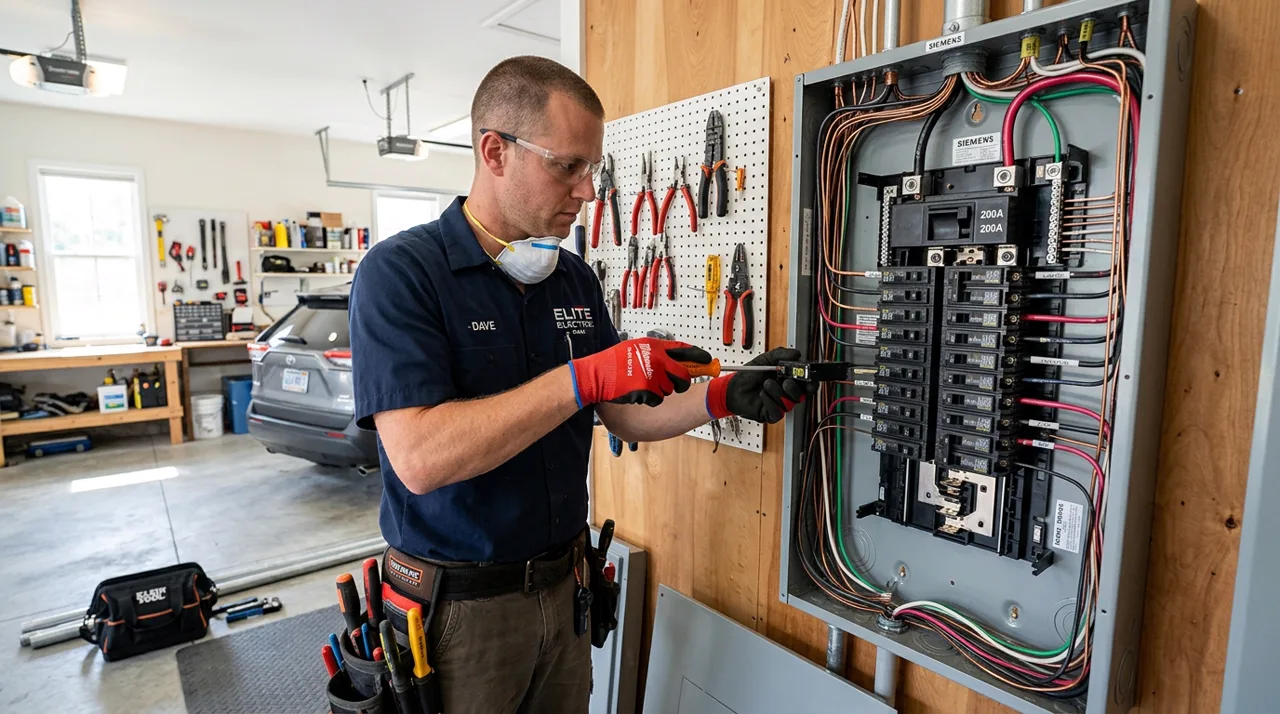
A panel upgrade is one of the few home improvement projects where cutting corners — or attempting DIY — can be genuinely life-threatening. It's always a licensed electrician job.
What Is an Electrical Panel Upgrade?
Your electrical panel — also called a breaker box, load center, or service panel — is the hub that distributes electricity from the utility into your home's individual circuits. It contains the main breaker (which controls all power to the home) and the individual circuit breakers that protect each circuit from overload.
An "upgrade" usually means one or more of three things: replacing an older or undersized panel with a larger one (more amperage capacity), replacing a panel that's reached end of life or has known safety issues, or increasing the amperage of the utility service feeding the home. These are related but distinct scopes of work, and the cost varies based on which combination applies to your situation.
The amperage capacity of your panel determines how much electrical load your home can draw simultaneously. A 100-amp panel was once standard and is still adequate for smaller homes without major electric appliances. A 150-amp panel is the minimum in many modern homes. A 200-amp panel is now the standard for new construction and most upgrade projects. Homes with significant electrical loads — EV charging, electric heat pumps, pool equipment, workshop tools — increasingly need 400-amp service.
Full Cost Breakdown by Upgrade Type
| Upgrade Type | Typical Cost Range | What's Included |
|---|---|---|
| Panel swap only (100A → 200A, same service size) | $1,500–$3,000 | New panel, breakers, labor, permit |
| 100A → 200A with service entrance upgrade | $3,000–$6,000 | Panel + new service wire + meter base |
| 60A fuse box replacement (full upgrade) | $3,500–$7,000 | Panel, service, grounding, code updates |
| 150A → 200A panel swap | $1,200–$2,500 | New panel, breakers, labor, permit |
| 200A → 400A service upgrade | $5,000–$12,000 | Utility upgrade + new panel/meter |
| Subpanel addition (100A) | $800–$2,000 | New subpanel, feeder wire, breakers |
| Subpanel for detached garage/ADU | $1,500–$4,000 | Subpanel + underground conduit run |
| Grounding system upgrade (older homes) | $500–$1,500 | Ground rods, bonding conductor |
| AFCI/GFCI breaker upgrades | $200–$800 | Code-required safety breakers |
| Full panel + whole-home rewire | $8,000–$20,000+ | Panel + all new branch circuit wiring |
The Three Types of Electrical Panel Work — And What Each Costs
Type 1: Panel Swap (Same Service Size)
This is the simplest scenario: your home already has a 200-amp utility service coming in, but the actual breaker panel is old, outdated, recalled, or has run out of circuit slots. The electrician replaces the panel enclosure and breakers while keeping the same service entrance wiring intact. This is the most straightforward panel job and the least expensive, typically requiring just a few hours of work plus inspection.
Common reasons for a panel swap without a service upgrade: outdated Federal Pacific Stab-Lok panels (associated with fire risk), Zinsco panels (breakers that don't trip reliably), or simply a panel that's physically full with no available spaces for new circuits.
Type 2: Service Upgrade (Increasing Amperage)
This is what most homeowners mean when they say "electrical panel upgrade" — they want to go from 100-amp to 200-amp service. This involves more than just swapping the panel box. The service entrance conductors (the thick wires that run from the utility transformer to your meter and panel) must be upsized to handle the higher amperage. In many cases the meter base also needs replacing. The utility company must be involved — they disconnect the power at the transformer for the service entrance work and reconnect it afterward.
This coordination with the utility company is what makes service upgrades more time-consuming. You need to schedule with both the electrician and the utility. In some areas the utility does their portion for free as part of the service agreement; in others they charge $200–$800 for their work.
Type 3: 400-Amp Service Upgrade
A 400-amp service is becoming increasingly relevant as homeowners add multiple EV chargers, all-electric HVAC systems, whole-home electrification, and sometimes a combination of all three. A 400-amp service typically uses two 200-amp meters (a "meter stack") or a single large meter, feeding either a large single panel or two 200-amp panels. This is a significant utility infrastructure job and almost always requires coordination with the power company months in advance in some markets.
Not every home or neighborhood can get 400-amp service — the utility transformer serving your street needs to have the capacity. In areas where the local grid is already stressed, the utility may require transformer upgrades at additional cost or may not offer it at all. Get a pre-approval from your utility before budgeting for 400-amp service.
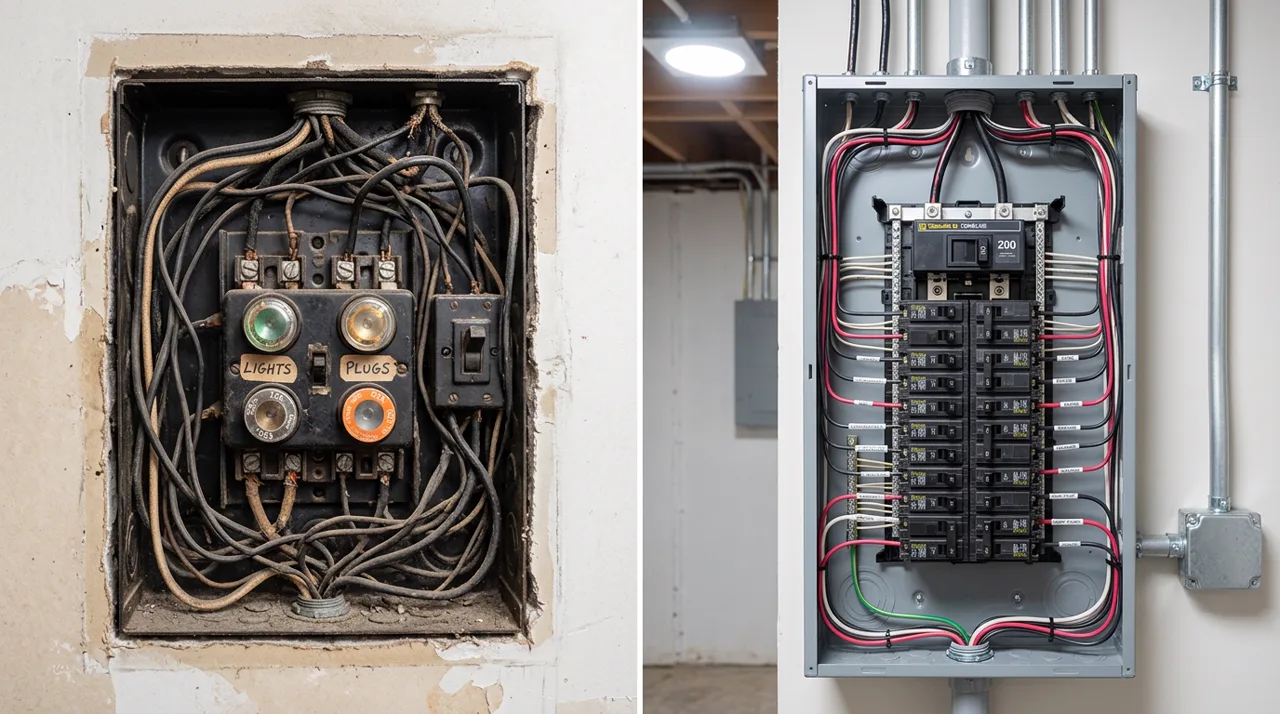
The difference between an old fuse box (left) and a modern 200-amp breaker panel (right) is dramatic — in safety, capacity, and insurance eligibility.
Signs You Need an Electrical Panel Upgrade
- Breakers trip frequently, especially when running multiple appliances
- You have a fuse box instead of a breaker panel
- Your panel is a Federal Pacific (Stab-Lok), Zinsco, or pushmatic brand
- Your home's service is 60-amp or 100-amp and you want to add EV charging
- Home inspector flagged the electrical system at purchase
- Insurance company is threatening non-renewal over electrical concerns
- Lights dim when large appliances start up
- Panel feels warm to the touch or shows scorch marks
- You're adding a home addition, ADU, or detached garage with significant loads
- Your panel is out of available circuit slots and you need more circuits
What the Job Actually Involves — Step by Step
Understanding what happens during a panel upgrade helps you evaluate quotes and set realistic timeline expectations.
Step 1: Electrician assessment. Before any pricing can be accurate, a qualified electrician needs to see your current panel, meter location, service entrance, and what you're trying to add. A good electrician will pull the panel cover, examine the wiring, assess the service entrance condition, and note any code compliance issues that will need to be addressed alongside the panel upgrade. This inspection is typically free or low-cost and should precede any signed contract.
Step 2: Permit application. Your electrician pulls the permit from your local building department. This establishes the scope of work officially and schedules an inspection upon completion. In most areas permits are pulled online now and can be approved same-day to within a few business days.
Step 3: Utility coordination. For any service upgrade, the electrician coordinates with your utility company to schedule the disconnect/reconnect. This is often the longest part of the timeline — utilities can take anywhere from a few days to several weeks depending on your area and current demand. Your power will be off for the period between disconnect and reconnect.
Step 4: Installation day. With utility power disconnected, the electrician removes the old panel, installs the new one, reconnects all circuits, installs new breakers (including any required AFCI/GFCI breakers), and connects the new service entrance conductors. This typically takes 4 to 8 hours for a standard upgrade.
Step 5: Inspection. Once work is complete, your local building inspector visits to verify the installation meets code. This is a pass/fail inspection. If anything doesn't meet code, the electrician corrects it before the final sign-off. Most reputable electricians know local code requirements well and pass first-time.
Step 6: Utility reconnection. Once the inspection passes, the utility reconnects power at the transformer. In some markets this happens same-day; in others you schedule it in advance.
What Drives the Cost Higher Than the Base Quote
Panel upgrade quotes often have a base number and then a list of "if needed" conditions that can add up quickly. Here's what to watch for:
Knob-and-tube or aluminum wiring. If your home has old knob-and-tube wiring or aluminum branch circuit wiring (common in 1960s–1970s homes), the panel upgrade may expose code issues that require remediation. Aluminum wiring at receptacles requires either replacement with copper or installation of CO/ALR rated devices. This can add $1,000–$5,000+ to the project.
Grounding deficiencies. Older homes often lack proper grounding systems. Upgrading to current code requires ground rods, bonding conductors, and in some cases ground fault protection throughout. Budget $500–$1,500 for a full grounding upgrade if your home is more than 40 years old.
AFCI breaker requirements. Modern electrical code (NEC 2020) requires arc-fault circuit interrupter (AFCI) breakers for most living spaces. If your electrician is pulling a permit for your upgrade, they'll need to bring affected circuits up to this standard. AFCI breakers cost $25–$50 each versus $5–$10 for standard breakers — on a 30-circuit panel that's a meaningful cost difference.
Meter base replacement. If your meter base is old or not rated for the new service size, it needs replacing. This is utility-specific work in some areas and can add $300–$800.
Panel location. A panel in an accessible utility room is straightforward. A panel buried in a finished basement, inside a closet, or in a difficult-to-access location adds labor hours and therefore cost.
Recalled Panels: Federal Pacific, Zinsco & Pushmatic
Three panel brands warrant specific attention because of documented safety concerns:
Federal Pacific Stab-Lok panels were installed in millions of American homes between the 1950s and 1980s. Research has documented that Stab-Lok breakers fail to trip at rates far higher than other brands, creating fire risk. If you have a Federal Pacific panel, replacement is strongly recommended — not just as a performance upgrade but as a safety necessity. Many insurance companies will not renew policies on homes with known Federal Pacific panels.
Zinsco panels (and their rebranded variants, including GTE Sylvania) have breakers that can weld to the bus bar over time, making them unable to trip during an overload. Like FPE panels, these should be replaced proactively regardless of apparent condition.
Pushmatic panels are not as definitively dangerous as the above two, but they use a push-button breaker design that can be difficult to reset and uses breakers that are now expensive and hard to source. Replacement is generally recommended when the panel needs service.
If you have any of these three brands, get your panel replaced as soon as practical. Your insurance company will thank you, and more importantly, so will your family.
Subpanels: When You Need More Circuits Without a Full Upgrade
If your main panel has adequate amperage but has run out of available circuit slots — a common situation in older homes where circuits have been added over the years — a subpanel is often the answer. A subpanel (also called a distribution panel or secondary panel) is fed by a double-pole breaker in your main panel and distributes power to a dedicated area.
Common applications include a detached garage (where running multiple individual circuits from the house would be expensive), a home workshop with high-demand tools, a basement that's being finished, or an ADU (accessory dwelling unit) that needs its own circuits. Subpanel costs depend primarily on size (amperage) and how far the feeder wire must run from the main panel.
For a detached structure, the feeder typically runs underground in conduit. Local code governs the burial depth (typically 18–24 inches for conduit) and the wire size required. A 60-amp subpanel in an attached garage might cost $800–$1,500. A 100-amp subpanel for a detached garage 100 feet away could run $2,000–$4,000.
Is 200 Amps Enough for Your Home?
For most homes, 200-amp service is comfortable. A typical 2,000–2,500 sq ft home with gas appliances, central AC, and standard lighting and outlets uses nowhere near 200 amps simultaneously at peak load.
Where 200 amps can become limiting: a home with multiple Level 2 EV chargers (each draws 40–50 amps at peak), combined with electric heat pump (20–50 amps), electric dryer (30 amps), electric water heater (30 amps), and an induction range (40–50 amps). In that all-electric scenario, you could theoretically approach 200-amp capacity during peak simultaneous use, though in practice loads rarely peak simultaneously.
If you're planning to fully electrify your home in the next 5–10 years — heat pump, heat pump water heater, EV charging, and induction cooking — consider whether to go straight to 400-amp service when you upgrade. It costs more now but avoids a second upgrade later.
How to Get an Accurate Electrical Panel Quote
Getting a reliable quote for electrical panel work requires a site visit — not a phone estimate. Any electrician quoting you over the phone without seeing your current panel, meter, and service entrance is guessing, and those guesses often turn into change orders after work begins.
Get quotes from at least three licensed electricians. In most states, residential electrical work requires a licensed electrical contractor. Verify the license through your state's contractor licensing board — it's a free online lookup. Confirm they carry liability insurance and workers' compensation.
A detailed quote should specify: the new panel brand and amperage, the number of breaker slots, whether service entrance conductors are included, whether the meter base is included, permit fees, the utility coordination process, and any known code upgrades that will be required. Ask specifically what happens to the cost if the inspector requires additional work — how do they handle that?
Don't choose solely on price. For electrical work, the quality of the installation, the thoroughness of code compliance, and the reliability of the warranty on workmanship matter more than saving $300 on the quote. An improperly installed panel is a fire hazard that no homeowner wants to discover the hard way.
Hiring an Electrician? Start With the Right Checklist
Our contractor checklist covers licensing, insurance, contract terms, and red flags — apply it to any trade, including electrical.
Frequently Asked Questions
How much does it cost to upgrade from 100A to 200A?
Upgrading from 100-amp to 200-amp service typically costs $1,500–$4,000 for a panel swap alone. With service entrance upgrades, permits, and utility work, total costs typically run $2,500–$6,000. Costs vary by region, permit fees, and whether the utility charges for their portion.
Do I need a permit to upgrade my electrical panel?
Yes — virtually every jurisdiction requires a permit. It triggers a required inspection that verifies the work meets code. Unpermitted electrical work can void your homeowners insurance and create issues at resale. Any electrician suggesting skipping the permit is a red flag.
How long does an electrical panel upgrade take?
Installation takes 4–8 hours. Full timeline from scheduling to final inspection is typically 1–3 weeks, accounting for permit processing, utility coordination, and the inspection appointment. Your power will be off 2–4 hours during the actual swap.
Is 200 amps enough for a modern home?
For most homes up to 3,500 sq ft with standard appliances, yes. Homes with multiple EV chargers, all-electric HVAC, and induction cooking may approach the limit. Homes planning full electrification should consider 400-amp service from the start.
Can I upgrade my electrical panel myself?
No. The service entrance conductors at the top of the panel are always energized and cannot be shut off by the homeowner — only the utility company can disconnect that power. This work requires a licensed electrician, a permit, and a municipal inspection.
What is a subpanel and when do I need one?
A subpanel is a secondary breaker box fed from your main panel for a specific area — garage, workshop, ADU, or addition. You need one when the area is far from the main panel or when your main panel has adequate capacity but no available slots. Subpanels cost $500–$2,500 installed for attached spaces, $1,500–$4,000 for detached structures.