Roofing & Exterior
Roof Replacement Cost: Materials, Labor & What Affects the Price in 2026
A roof replacement is one of the largest single-line items in a homeowner's lifetime maintenance budget. It's also one of the most anxiety-inducing, because most people have no idea what it should actually cost until a contractor is standing in their driveway with a clipboard. The price variation is enormous — you might get quotes ranging from $9,000 to $22,000 for the exact same roof, and not know which one is honest. This guide breaks down exactly what drives roof replacement costs in 2026, what each material type realistically costs, and how to make sure you're getting a fair price.
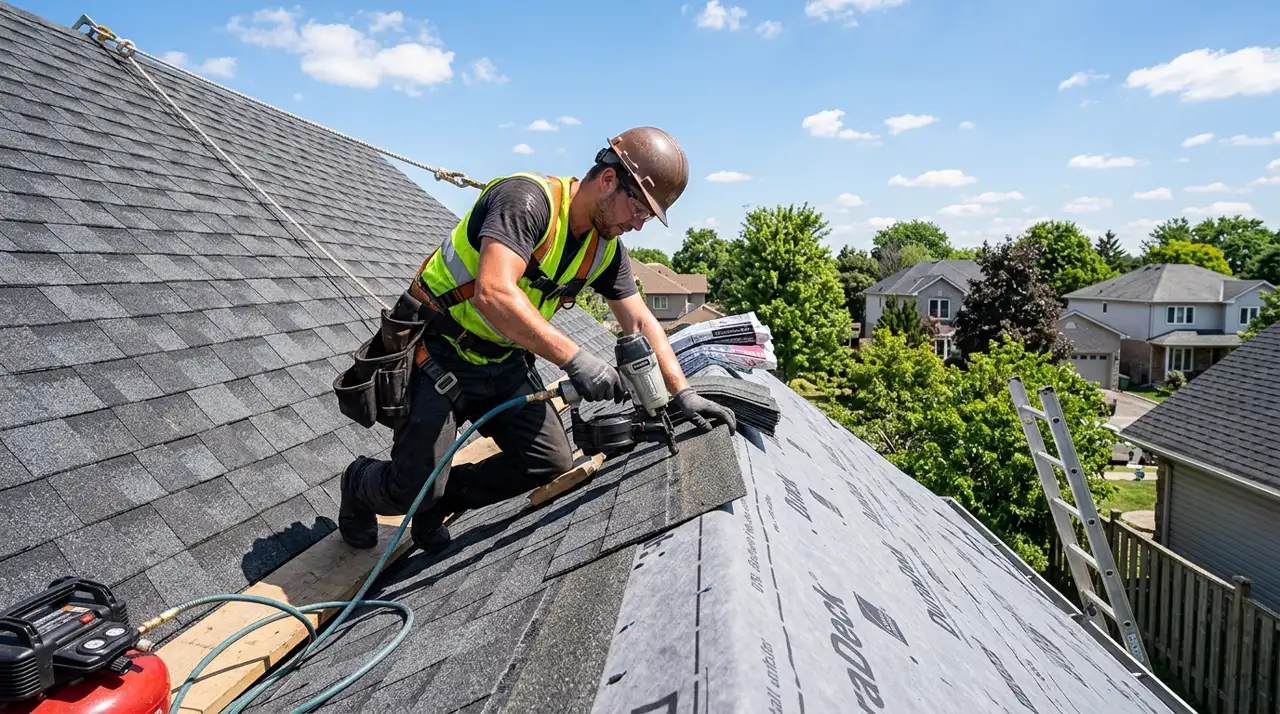
Roof replacement is one of the most disruptive — and most expensive — home improvement projects most homeowners will face. Understanding the cost components helps you evaluate quotes accurately.
How Roofing Is Priced: The Basics
Before diving into material-by-material costs, it helps to understand the unit economics of roofing. Contractors price roofing work by the "roofing square" — a 100 square foot area. A 2,000 sq ft home doesn't have a 2,000 sq ft roof; once you factor in pitch (the slope of the roof) and overhangs, the actual roof surface area is typically 15–30% larger than the home's footprint. A 2,000 sq ft ranch house might have 22 to 26 roofing squares to cover.
The total cost of any roof replacement has three main components: materials (shingles or panels, underlayment, ridge caps, flashing, nails), labor (tear-off and disposal of old roofing, installation of new), and overhead (permits, insurance, dump fees, contractor profit margin). On a typical asphalt shingle job, materials account for roughly 40% of the total and labor about 60%. On premium materials like slate or tile, that ratio shifts — materials become a larger share because they cost so much more.
Material-by-Material Cost Breakdown
| Material | Cost per Sq Ft (installed) | Lifespan | Best For |
|---|---|---|---|
| 3-Tab Asphalt Shingles | $3.50 – $5.50 | 20–25 years | Budget-conscious, simple roof shapes |
| Architectural (Dimensional) Asphalt | $4.50 – $8.00 | 25–30 years | Most homes — best value overall |
| Premium Designer Asphalt | $7.00 – $12.00 | 30–50 years | Curb appeal, impact resistance |
| Standing Seam Metal | $10.00 – $18.00 | 40–70 years | Longevity, snow/rain performance |
| Metal Shingles / Panels | $7.00 – $14.00 | 30–50 years | Traditional look + metal durability |
| Clay or Concrete Tile | $10.00 – $20.00 | 40–50+ years | Mediterranean / Spanish architecture |
| Natural Slate | $15.00 – $35.00+ | 75–150 years | Historic homes, ultimate longevity |
| Synthetic Slate / Shake | $8.00 – $14.00 | 30–50 years | Slate look without the structural cost |
| Wood Shake | $6.50 – $11.00 | 20–30 years | Rustic aesthetic, moderate climate |
| TPO / EPDM (flat roofs) | $4.00 – $8.00 | 15–25 years | Low-slope and flat roofs only |
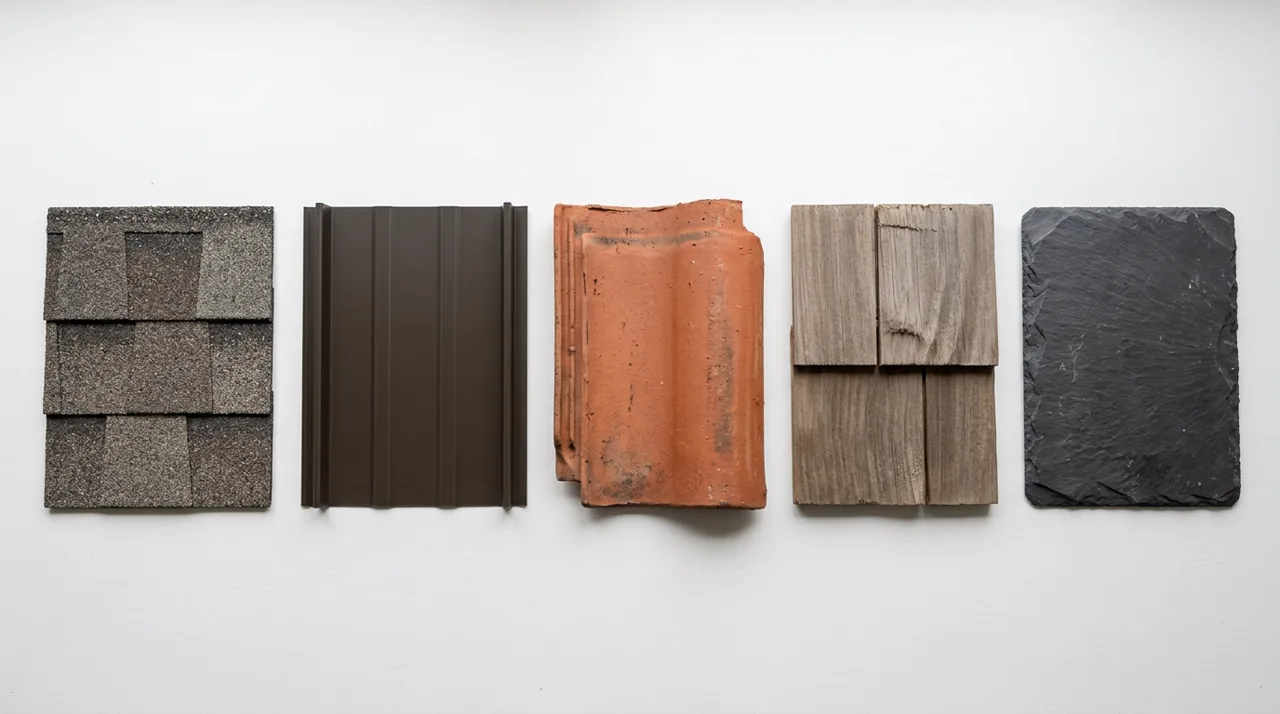
From left: asphalt shingles, metal panel, clay tile, wood shake, and natural slate — five materials with vastly different price points, lifespans, and structural requirements.
The Most Popular Choice: Architectural Asphalt Shingles
Architectural (Dimensional) Asphalt Shingles
This is what goes on the vast majority of American homes — and for good reason. Architectural shingles are the sweet spot of cost, durability, ease of installation, and availability. They're made with a heavier fiberglass mat than 3-tab shingles, layered to create a textured, dimensional look that mimics wood shake. Most carry a 30-year warranty, though real-world lifespan in moderate climates is often 25–30 years.
For a 2,000 sq ft home with 22–24 roofing squares, expect to pay:
When Metal Roofing Makes Sense
Standing Seam Metal Roofing
Metal roofing has grown enormously in popularity over the past decade, and for legitimate reasons. A properly installed standing seam metal roof can last 40–70 years, sheds snow and water more efficiently than shingles, reflects solar heat reducing cooling costs, and is virtually impervious to the impact damage that puts asphalt roofs on the insurance company's radar every hail season. The catch: it costs roughly twice what asphalt does, and it requires skilled installers — not every roofing company does metal work well.
Premium Materials: Tile, Slate & Synthetics
Clay & Concrete Tile
Tile roofing is a staple in the Southwest, Southeast, and wherever Mediterranean-style architecture is common. Clay tile is the genuine article — fired ceramic that can last well over 50 years, is completely fireproof, and looks stunning. Concrete tile offers similar longevity at a lower material cost. The critical caveat: tile is extremely heavy (8–12 lbs per square foot vs. 2–3 lbs for asphalt). Most homes built for asphalt or wood shake roofs need structural reinforcement before tile can be installed, adding to the overall cost.
Natural Slate
Natural slate is the undisputed king of roofing longevity. A slate roof on a 19th-century New England home may still be doing its job today. It's completely fireproof, doesn't absorb water, and ages beautifully. The price is equally extraordinary: $30,000 to $75,000+ for a typical home, driven by both the material cost (slate is quarried, cut, and graded by hand) and the highly specialized installation labor. It also requires structural reinforcement in virtually every home.
Synthetic Slate & Shake
Modern synthetic roofing products — made from rubber, plastic composites, or recycled materials — have gotten genuinely good. They replicate the look of slate or wood shake without the weight penalty or cost premium, typically carrying 30–50-year warranties. Class 4 impact-rated synthetic products can also earn insurance discounts in hail-prone states. At $8–$14 per square foot installed, they're positioned between architectural asphalt and real tile.
The 8 Factors That Affect Your Final Quote
Two homes of the same size can produce quotes that are $8,000 apart with the same material. Here's why.
1. Roof size and pitch. Steep roofs require safety equipment, slower work, more physical exertion — and higher labor rates. A 12/12 pitch (45-degree angle) roof can cost 20–40% more to roof than a 4/12 pitch roof of the same area.
2. Number of layers being removed. Most building codes allow a maximum of two layers of asphalt shingles before a complete tear-off is required. If your home already has two layers on it, they all have to come off — which adds significant tear-off labor and disposal cost, typically $500–$2,000 extra.
3. Decking condition. Once old shingles are stripped, the plywood or OSB decking underneath is inspected. Soft spots, rotted sections, and damaged sheathing must be replaced before new roofing goes down. Decking repairs typically run $70–$120 per sheet of plywood replaced. It's not unusual for a roof job to discover $1,000–$3,000 in decking repairs that weren't in the original quote.
4. Flashing replacement. Flashing — the metal strips that seal roof penetrations like chimneys, skylights, dormers, and pipe vents — should be replaced or reflashed during a roof replacement. If a contractor's quote omits flashing replacement, that's a red flag. Budget $200–$600 per penetration for quality flashing work.
5. Roof complexity. A simple gable roof with two flat planes is fast to roof. A roof with multiple valleys, hip returns, dormers, turrets, or skylights requires precise cutting, more waste material, and significantly more labor. Highly complex roofs can run 25–50% more per square than simple ones.
6. Underlayment and ice & water shield. Code typically requires synthetic underlayment across the field and self-adhering ice and water shield in vulnerable areas (eaves, valleys). Some contractors quote the minimum; others upgrade to premium synthetic underlayment and extend ice shield coverage. The difference in material cost is relatively modest ($500–$1,500) but makes a real difference in long-term performance.
7. Regional labor markets. A roof that costs $11,000 in Indianapolis might cost $16,000 in Boston and $19,000 in San Francisco. Roofing labor rates track local construction market conditions closely. This is worth knowing if you're comparing online estimates to actual local quotes.
8. Time of year. Roofing demand spikes in spring and fall. Summer is busy in northern markets; spring is peak season in the South. Scheduling your replacement in late fall (after the busy season) or late winter can sometimes yield better pricing or faster scheduling from contractors who want to fill their calendar.
Signs It's Time to Replace — Not Repair
Not every roofing problem requires a full replacement. Knowing when to repair versus replace can save you thousands — or prevent you from wasting money on patches that won't hold.
Replace if: Your roof is approaching or past its expected lifespan (20+ years for asphalt). More than 25–30% of shingles are damaged, curling, or missing. You have multiple active leaks in different locations. The decking underneath is soft or damaged in multiple areas. You've repaired the same areas more than twice. An insurance claim involves widespread storm damage.
Repair if: Damage is confined to a small, clearly defined area. The roof is under 15 years old and otherwise in good condition. A single leak traces to a specific failed flashing or damaged section. You're planning to sell within two or three years and the roof has remaining life.
Does Insurance Cover Roof Replacement?
This is one of the most misunderstood topics in roofing. Here's the honest breakdown:
Homeowners insurance covers roof damage caused by sudden, accidental events — hail, wind, fallen trees, fire. It does not cover wear and tear, age-related deterioration, or poor maintenance. If your 22-year-old asphalt roof has lost its granules and is leaking, that's considered normal wear and your claim will likely be denied.
After a significant hail or wind event, get a professional inspection from a licensed local contractor before calling your insurer. If there's damage, file the claim. Your insurer will send their own adjuster. If the adjuster and your contractor disagree on scope, a public adjuster can help you negotiate.
One important policy distinction: Actual Cash Value (ACV) policies pay you the depreciated value of your old roof. Replacement Cost Value (RCV) policies pay what it actually costs to replace it with like-kind materials. ACV policies are cheaper but leave you holding more of the bill. Review which type you have before you need it.
How to Evaluate Roofing Quotes
Getting three quotes is the starting point, not the whole strategy. Here's what to look for when comparing them.
Detailed scope of work. A legitimate roofing quote should specify exactly what is being installed: shingle brand and product line, underlayment type and spec, ice and water shield coverage area, flashing replacement or reuse, ridge vent type, and what happens to decking damage if found. A one-line quote ("replace roof, 22 squares, $11,500") tells you almost nothing.
Warranty information. You want two warranties: the manufacturer's warranty on the materials, and the contractor's workmanship warranty. Manufacturer warranties only apply when the product is installed by an authorized installer following their specifications. Make sure your contractor is authorized by the manufacturer they're quoting — it affects whether the warranty is actually valid.
Permits and inspections. In most jurisdictions, a full roof replacement requires a permit and final inspection. If a contractor says they "don't bother with permits," that's a red flag — unpermitted roofing can create problems at resale and may void your manufacturer warranty.
Payment terms. Never pay the full amount upfront. A reasonable deposit is 25–33% to cover material orders. Final payment should be held until the job is complete, the site is cleaned up, and a final inspection has passed.
Not Sure Which Contractor to Trust?
Our complete contractor hiring checklist covers licensing, insurance, contract terms, and red flags — everything you need before signing.
Frequently Asked Questions
How much does a roof replacement cost on average?
The average roof replacement for a typical 2,000 sq ft home with standard architectural asphalt shingles costs between $9,000 and $16,000 installed. Metal roofing runs $18,000 to $35,000, clay or concrete tile $20,000 to $40,000, and natural slate $30,000 to $75,000 or more.
How long does a roof replacement take?
Most residential roof replacements are completed in one to three days for a standard 2,000 sq ft home with asphalt shingles. Larger homes, complex roof shapes, or premium materials like tile or slate can take four to seven days or more.
Should I repair or replace my roof?
If your roof is under 15 years old and damage is confined to a small area, repair is usually the better financial decision. If the roof is more than 20 years old, has widespread granule loss, multiple leaks, or sagging sections, replacement is more cost-effective in the long run.
Does homeowners insurance cover roof replacement?
Homeowners insurance typically covers roof replacement when the damage is caused by a covered peril — most commonly hail, wind, or fire. Age-related wear and neglect are almost never covered. Review your policy: some insurers pay actual cash value (depreciated) while others pay replacement cost value.
What is the cheapest roofing material?
3-tab asphalt shingles are the least expensive roofing material, typically costing $3.50 to $5.50 per square foot installed. However, they carry a shorter warranty (20–25 years) and are being largely replaced in popularity by architectural shingles, which cost only slightly more but last significantly longer.
How do I know when my roof needs replacing?
Key signs include: missing or curling shingles, granule loss visible in gutters, daylight visible through the attic, sagging sections, multiple active leaks, and age over 20–25 years for asphalt shingles. If more than 25% of the shingles are damaged, replacement is usually more economical than continued patching.